

Under construction 10.4.26.
Where Our Values Become Courageous, Shared Action
At some point, living the Way of the Universe values asks those who are able to carry them beyond our own front door. Personal growth becomes a foundation for something larger: helping our groups, communities, workplaces, and nations become wiser, fairer, and more capable of protecting life. This is where the rubber meets the road—and where the road occasionally asks whether we brought a map.
Welcome to the most demanding part of the Way of the Universe’s advanced training: choosing an area of the world you can help improve, then preparing to act effectively and responsibly.
The strategies that follow address a difficult challenge: changing the behavior and structures of an individual, group, organization, community, corporation, or nation that uses wealth, influence, control, or other forms of power to preserve its advantage at the expense of others’ well-being. Some resist change deliberately. Others do not recognize the harm they cause. Either way, good intentions alone rarely change the arrangement. Privilege can become remarkably attached to its reserved parking space.
Your first prerequisite is a supportive network that practices the Way of the Universe’s values and principles together. Build that foundation before beginning these strategies. You need people who offer encouragement, share responsibility, question your assumptions, and help you recover when the work becomes difficult. A healthy network supports your courage while keeping your judgment accountable. Sometimes its most valuable contribution is a kind voice saying, “Let’s check that conclusion before we print the banners.”
The second prerequisite is the thinking needed to understand what you are trying to change. Before independently planning an improvement effort at this level, you need to have mastered the rational thinking, evidence evaluation, analysis, and metacognition skills taught in the Universe Institute’s beginner and intermediate courses. Metacognition means examining your own thinking: noticing assumptions, recognizing uncertainty, and correcting errors—including the particularly convincing errors that happen to be ours.
Building on that foundation, strategic planners also need practical command of systems theory and advanced DMAP: dialectical, metasystemic analysis and problem-solving. These are challenging skills. They help us examine relationships, competing perspectives, feedback, changing conditions, and the larger systems surrounding a problem. Understanding the vocabulary is a beginning; using the methods accurately, with critical review, is the preparation this work requires.

That preparation becomes especially important when larger groups behave as complex adaptive systems: interconnected people and institutions that respond, learn, and change, producing results no single participant fully controls. Change one part, and other parts may adjust, resist, cooperate, or create unexpected consequences. A corporation or nation seldom behaves like a toaster. Even a toaster sometimes has opinions.
For that reason, the planner must conduct both a detailed systems analysis and a detailed DMAP analysis, then revise the proposed actions (listed below) using what each analysis reveals. The aim is to reduce harm, protect useful functions, anticipate consequences, and build arrangements that remain accountable after the initial campaign succeeds. Careful preparation cannot guarantee success, but it can expose mistakes before other people bear their costs.
Happily, everyone in your support network does not have to become the overall strategic planner. Those responsible for designing and revising the strategy need the full preparation described above. People carrying out particular steps need clear information, appropriate training, and support for their own responsibilities. They also need to understand relevant risks, how to report unexpected developments, and when to pause and seek help. Their experience should inform the plan as it evolves.
There is room here for many kinds of contribution: listening, researching, organizing, communicating, negotiating, documenting, and caring for the people doing the work. A thoughtful team makes demanding change possible through shared effort.
Begin with a manageable area where your preparation, relationships, and resources give you a realistic opportunity to help. Expect resistance, uncertainty, and revision. Measure progress by improvements in people’s lives and the accountability of institutions.
This is where individual improvement and evolution can grow into effective collective improvement and evolution. We learn to become steadier people so we can help build steadier institutions. We practice living our values together so those values can take root in the world.
Bring courage. Bring companionship. Bring your best thinking—and enough humor to remember that even serious work is being done by wonderfully imperfect humans. As you will discover below successful social action requires wise and detailed planning.
On this page:
Quick start · Five levels · Procedure · Systems analysis · DMAP analysis · Individuals · Small groups · Communities · Corporations · Nations · Successes · Planning form · FAQ · Glossary · Sources
Power can be changed. People have challenged exploitation, reduced dangerous practices, opened closed institutions, and made powerful organizations answer for their actions. The work usually takes evidence, cooperation, persistence, and rules that keep working after the celebration.
This advanced Way of the Universe guide is for people working beyond personal improvement: members, small groups, community organizers, workers, business leaders, and public servants. It helps you turn Right Action and Right Attitude into a practical response when an individual or institution uses power to cause widespread or lasting harm.
You will learn to identify how harm is sustained, choose methods suited to the situation, protect affected people, and check whether conditions actually improve. Bring courage, curiosity, and a notebook. Outrage can start the engine; it is less reliable as the entire navigation system.
The short version: protect people, change the machinery, check the result
Define the harmful conduct and the outcome you want. Work with people affected by it. Map the decisions, incentives, dependencies, and rules that allow it to continue. Complete an additional detailed systems analysis and a separate DMAP analysis. Use both to revise your plan before consequential action.
Then combine suitable methods: conversation where useful, organized representation, credible alternatives, independent oversight, public accountability, negotiation, and enforceable remedies. If cooperation fails, consider proportionate nonviolent pressure and legitimate institutional action. Measure reduced harm and stronger accountability, rather than applause or promises.
The aim is to end destructive conduct and the arrangements that reproduce it. Wealth, leadership, and organizational size do not themselves establish wrongdoing. Demonstrated harm, unjust exclusion, and unaccountable control are the concern.
Begin today: write one specific harm, one concrete change, one affected group, and one decision-maker who could authorize that change. If there is immediate danger, seek appropriate protective assistance now; a finished diagram is not a prerequisite for safety.
Choose your reading depth
- One-page route: read the short version, the five-level action map, and your next step.
- Two-page route: add the ten-step procedure, the resistance check, and the planning form.
- Full-study route: work through the evidence, systems and DMAP requirements, historical examples, and critical review.
These are reading paths, not guaranteed print lengths. Start with the part that matches your responsibility, then study the rest before wider implementation.
What the evidence can—and cannot—promise
Some procedures have credible causal evidence in particular settings. Others have comparative historical support, observational evidence, or useful institutional guidance. There is no scientifically established universal winner across a coercive individual, a corporation, a town, and a national government.
The ten-step procedure on this page is a proposed synthesis. It has not been tested as a complete program. Our commitments to dignity, justice, freedom, ecological care, and accountable power are ethical choices. Studies help us judge which actions may serve them under actual conditions.
Evidence worth taking seriously
| Method and evidence | What was found | Application and limit |
|---|---|---|
| Nonjudgmental narrative conversations: three U.S. field experiments. [1] | Small reductions in exclusionary attitudes; one effect lasted at least four months. Arguments alone showed no detectable effect in that experiment. | Try careful listening and reciprocal stories when participation is safe. This does not establish a method for reforming an abusive leader or ending profitable exploitation. |
| Government safety inspections: California field experiment. [2] | Inspected workplaces had 9.4% lower injury rates relative to controls, with no detectable losses in the business outcomes studied. | Give oversight authority, competent staff, and follow-through. This is a result from one setting, not a claim that every regulation has no costs. |
| Public-project audits: randomized Indonesian road-project study. [3] | Raising announced audit coverage from 4% to 100% reduced measured missing expenditure by eight percentage points. Grassroots monitoring had limited average effects. | Independently verify spending and connect findings to consequences. Missing expenditure is the study’s indicator; the result is not an eight-percent universal corruption reduction. |
| Municipal audits: Brazil’s randomized audit program. [4] | Previously audited municipalities showed an estimated 8% reduction in subsequent measured corruption. | Repeated oversight can alter incentives. Capacity to investigate and impose appropriate consequences matters; copying an audit label is insufficient. |
| Independent auditor incentives: Gujarat industrial-pollution experiment. [5] | Changing the audit arrangement improved truthful reporting and reduced pollution at treated plants. | Address who selects and pays the auditor, verify accuracy, and act on findings. A badge saying “independent” cannot supply independence by itself. |
| Community monitoring: Uganda studies. [6] [7] | A 2009 experiment improved service use and health outcomes. A larger study, published in 2026, found modest provider-behavior improvements but no effects on citizen pressure, utilization, or final health outcomes. | Participation can help under particular conditions. A meeting and a report card are not dependable substitutes for resources, authority, or effective remedies. |
| Corporate boycotts: observational U.S. research. [8] | Media attention was associated with concessions, especially where a company’s reputation had already declined. | A clear demand and credible public scrutiny may matter. The study cannot prove that publicity causes every concession or that every boycott succeeds. |
| Nonviolent civil resistance: comparative historical research. [9] | Campaign outcomes vary; Chenoweth’s 2020 analysis documents declining effectiveness during the 2010s and emphasizes movement capacity and state responses. | Build durable organization and a strategy suited to conditions. Neither a large rally nor a fixed participation percentage guarantees victory. |
Our practical inference: when harm survives because it is profitable, protected, or difficult to challenge, combine people’s voice with mechanisms that alter incentives and constrain conduct. Stronger institutions and organized participation can complement each other. This is a reasoned recommendation, not a result from a trial comparing every possible combination.
Why wealth and power can feel like gravity
Accumulated advantage can create reinforcing feedback. Assets generate income; income can finance further assets, expertise, and influence. Influence can sometimes secure rules or access that protect the original advantage. Each connection needs evidence in the case you are examining. [10] [11]
Ordinary compounding explains part of this. At the same hypothetical 5% return, $10,000 produces $500 in a year while $10 million produces $500,000. The larger fortune gains more money at the same percentage rate. It does not automatically grow faster in percentage terms.

Norwegian administrative research found persistent differences in investment returns and a positive association between returns and wealth. This supports concern about cumulative advantage, but it does not show that every wealthy person earns higher returns or that wealth always increases. Losses, taxes, competition, risk, and institutional rules matter. [10]
Policy capture is a separate problem: public decisions repeatedly favor a particular interest at the expense of the public interest. The OECD recommends diverse participation, usable transparency, accountability, and institutional integrity. Legitimate advocacy should be distinguished from corruption and from unfair exclusion. [11]
“Gravity” is a metaphor, not a natural law of politics. In our working model, look for this possible loop: concentrated resources support influence; influence weakens constraints; weak constraints permit further extraction; extraction increases concentrated resources. Also look for forces that interrupt it, such as competition, worker representation, independent courts, and effective oversight.

An expensive yacht is not a diagnosis. A documented practice that poisons a river, suppresses truthful reporting, or buys exemption from fair rules gives us something concrete to investigate. Wealth may arrive with an excellent accountant. Accountability still needs one of its own.
Why a reasonable request can meet unreasonable resistance
Reform may threaten income, status, control, professional identity, or an investment that someone cannot easily abandon. A person may also fear that admitting one mistake opens the door to many claims. These are possible mechanisms to investigate, not diagnoses of everyone who disagrees. Power asymmetries and exclusion are central concerns in the World Bank’s governance research. [12]
- Material advantage: continued harm is cheaper or more profitable than correction. Examine prices, bonuses, liability, contracts, and who pays the costs.
- Dependence: people need the employer, landlord, platform, supplier, or state service. Develop credible alternatives and transition support.
- Gatekeeping: the same actors control decisions, information, appointments, and appeals. Separate these functions and establish independent review.
- Identity and status: criticism is experienced as humiliation or disloyalty. Offer a dignified route to verified correction while preserving accountability.
- Collective-action difficulty: many people bear a small part of the cost, while a few beneficiaries are highly organized. Share organizing work and lower participation burdens.
- Uncertainty or genuine disagreement: the proposal may have defects. Test competing explanations and improve the plan rather than labeling every objection resistance.
For each suspected mechanism, record supporting evidence, counterevidence, and a response. Privilege rarely volunteers to carry the moving boxes. A workable plan identifies the door, the legitimate decision process, and who has authority to open it.
The five-level action map
| Level | Start here | Build toward |
|---|---|---|
| Individual actions | Define the conduct, document safely, seek support, and make a specific request where safe. | Boundaries, representation, formal complaint, and independent remedy. |
| Small-group actions | Agree on a bounded goal, roles, evidence, and protection for participants. | Coalition, negotiation, and sustained nonviolent pressure tied to an achievable demand. |
| Community actions | Include affected people and map the authority, budgets, services, and dependencies. | Oversight with resources, enforceable commitments, accessible participation, and reliable alternatives. |
| Corporate actions | Examine incentives, audit independence, worker voice, and board responsibility. | Binding controls, honest measurement, remedy, and leadership or business-model change when warranted. |
| National actions | Connect civic organization to institutions that can enact and enforce reform. | Accountable law, democratic checks, anti-capture protections, and a protected transition. |
Responsibility increases with control, knowledge, and capacity. A person struggling to pay rent should not be assigned the same burden as a board controlling a harmful business practice. The five levels connect, but one person does not have to perform all five jobs.
A ten-step procedure for accountable change
Use this proposed procedure with your existing advanced-course decision brief. Adapt its depth to the stakes and your legitimate authority. It is a learning structure, not a certification or guarantee. [31]
1. Define the conduct, the harm, and the required change
Replace “they are destructive” with a testable account: what action occurs, who is affected, how often, and what evidence links the action to the harm? Separate direct observation, interpretation, allegations, and unknowns. Define a bounded outcome, such as independently verified reductions in unlawful discharge or timely payment of wages owed.
Distinguish an emergency protective step from a longer reform. Record what happens if you act, wait, or do nothing. State whose rights and essential needs you are protecting.
2. Work with affected people and establish legitimate authority
Ask affected people what they need, what they fear, and how they wish to participate. Include people who cannot attend public meetings. Do not publish their identities or experiences without appropriate permission. Confirm who can investigate, negotiate, authorize, enforce, and hear an appeal.
Your philosophical commitment does not grant power over someone else’s life. Representation must be accountable to the people represented. Build a protection and support plan before asking vulnerable people to take public risks. [15]
3. Build and challenge the evidence record
Keep a dated ledger of sources, observations, reliability, missing information, and competing explanations. Use lawful records, authorized inspections, competent testing, and consent-based testimony. Keep original material secure and distinguish verified facts from accusations.
Give fair opportunities for response through appropriate procedures, without exposing witnesses or treating intimidation as a rebuttal. Ask an independent reviewer what evidence would change your conclusion. A compelling story deserves a competent fact-check.
4. Complete a detailed systems analysis
Go beyond the earlier course’s general systems map. Analyze the specific destructive source, its surrounding institutions, and the arrangements that reproduce its power. Map decision rights, money, information, dependencies, feedback, delays, and routes of correction. The detailed requirements below explain how.
5. Complete a separate detailed DMAP analysis
Use Dialectical Metasystemic Analysis and Problem-Solving to examine what the first analysis leaves fixed, isolated, contradictory, or incomplete. Consider context, process, relationships, and transformation. For an advanced project claiming full DMAP coverage, work through the relevant 28 thought forms with suitable training or qualified assistance. Four introductory questions do not establish mastery. [29] [30]
6. Revise the plan using both analyses
Maintain a revision log: original assumption; systems insight; DMAP insight; resulting change; remaining uncertainty; test or review. Change the objective, sequence, partners, proposed leverage, protections, or stopping conditions where the analysis calls for it. Recording two maps and proceeding unchanged without explanation does not meet this requirement.
Compare at least a cooperative route, an oversight or enforcement route, and a credible alternative or pressure route. A mixed approach may be better. Include doing nothing or delaying when those options help clarify consequences.

7. Build the capacity and negotiate a verifiable remedy
Assign responsibilities, budget, decision procedures, communication, legal or technical help, and care support. Present the evidence and a specific proposal to the appropriate decision-maker when safe. Ask for an agreement naming actions, resources, deadlines, independent verification, remedy, and consequences for nonperformance.
Offer a feasible route to compliance. Appropriate transition help may protect workers and essential services. It must not require harmed people to surrender basic rights, forgive misconduct, or accept continued injury.
8. Apply proportionate pressure and institutional remedies when needed
If a credible proposal is refused or ignored, use the power map to choose a method connected to the decision: organized representation, regulatory complaints, public-interest litigation through qualified counsel, shareholder procedures, responsible purchasing changes, or nonviolent civic action. Check local law, organizational authority, resources, and exposure before action.
Escalation is conditional, not automatic. A single well-supported complaint may be sufficient; another case may need several channels. Direct measures at the harmful conduct and responsible institutions. Threats, harassment, sabotage, and punishment of uninvolved people undermine the values we are trying to practice.

9. Test, monitor, adapt, and protect essential functions
Where appropriate, begin with a bounded change that is reversible and unlikely to cause serious harm if it fails. Do not pilot avoidable danger on people without legitimate authority and appropriate participation. Some legal protections must be enforced immediately rather than subjected to a discretionary experiment.
Measure outcomes, implementation, retaliation, cost displacement, and unintended effects. Use a baseline and a credible comparison where feasible. Keep essential services operating or provide safe alternatives. Review emerging evidence and adjust before expanding the intervention.
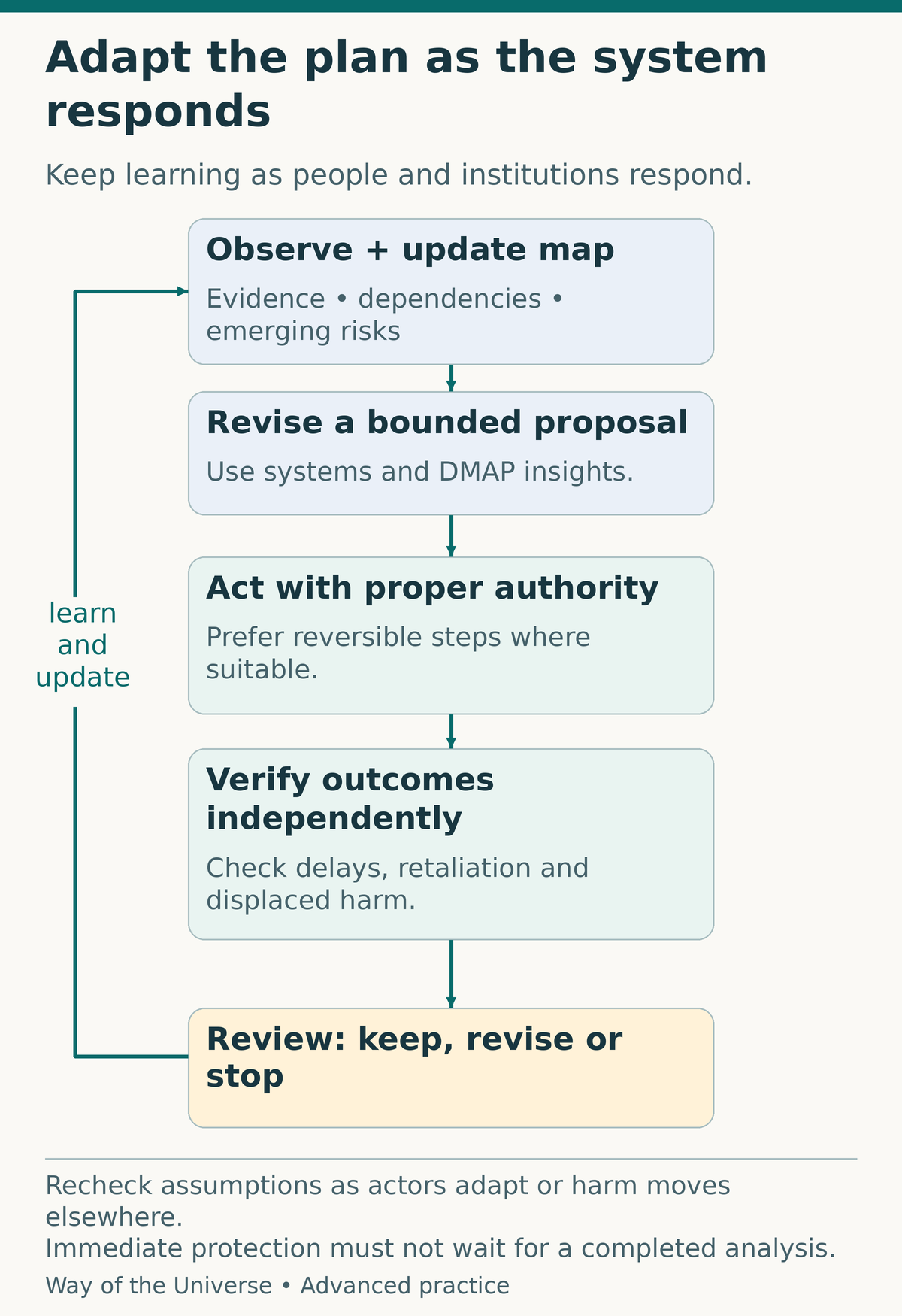
10. Secure the change and keep the new power answerable
Put the improvement into funded rules, contracts, oversight, accessible challenge, and maintenance. Verify compliance after the public announcement. Preserve records of dissent and unresolved harms. Recheck whether the old practice has moved into another company, jurisdiction, subcontractor, or technology.
Sometimes authority must be limited or a leader replaced through legitimate processes. Plan continuity, fair remedy, and independent scrutiny of the replacement. A new face in the same unchecked chair can quickly develop a strong attachment to the chair.
Required analysis level one: a detailed systems map of harmful power
A complex adaptive system contains interacting people and institutions that learn and respond. They may change suppliers, messaging, alliances, prices, or organizational structure when challenged. Outcomes can be delayed, nonlinear, or different at different scales. Treat those possibilities as questions to investigate, not an excuse to claim that everything is unknowable.
Meadows’ leverage-point framework invites attention to information, feedback, rules, goals, and deeper assumptions. It is a conceptual guide, not a validated ranking that tells you the best intervention in every case. [14]
Produce these six practical records
- Boundary and time record: define the conduct, affected population, ecological effects, geographic reach, past trajectory, and future risks. Explain what your map leaves out and why.
- Power and dependency map: identify owners, managers, workers, customers, funders, regulators, courts, media, and community representatives where relevant. Show formal authority and informal influence separately. Include reform-minded insiders and people with mixed interests.
- Resource and information map: trace money, contracts, assets, access, reporting, appointments, and appeals. Which essential service makes people dependent? Who knows about the harm, who can verify it, and who can suppress correction?
- Feedback map: identify how benefits encourage repetition, how costs are displaced, and which checks fail. Mark each relationship as observed, supported inference, or hypothesis. Include delays, thresholds, and connections across scales.
- Intervention comparison: identify at least three plausible changes. For each, name the decision owner, mechanism, resources, evidence, likely response, distribution of costs, and conditions under which it could fail.
- Monitoring and continuity plan: choose outcome measures and warning signs. Identify essential functions, responsible monitors, review dates, appeal routes, and conditions for stopping or changing the intervention.
Make each causal connection specific
“Money causes corruption” is too broad to guide action. A usable claim might be: “Contractors finance the appointment process; appointees choose the auditors; auditors who report problems lose future work.” Each connection needs case evidence. A different explanation might be inadequate staffing rather than compromised appointments.
Ask how actors could adapt: shift harm elsewhere, replace employees, change ownership, influence the verifier, or report a misleading indicator. Then ask how affected people might also adapt and gain agency. Build responses into the plan without assuming every anticipated maneuver will occur.
Required analysis level two: a detailed DMAP review
DMAP, as used here, draws on Otto Laske’s Dialectical Thought Form framework. The Universe Institute describes its analysis-and-problem-solving application. Neither adopting the terminology nor completing this page demonstrates that DMAP causes successful institutional reform. Treat insights as propositions to examine against evidence. [29] [30]

Context: what larger wholes and boundaries matter?
Place the destructive source inside its economic, legal, cultural, technological, and ecological setting. What looks voluntary when viewed as one contract but coercive when viewed through a person’s available alternatives? What differs across local, national, and global scales? Who is missing from the original definition of the problem?
Process: what is changing, emerging, or being kept artificially fixed?
Trace how the arrangement developed, how it maintains itself, and what is changing now. Examine unresolved tensions: short-term profitability and long-term viability; public promises and operational rewards; apparent stability and accumulating damage. Which evidence shows a real trend, and which reflects a temporary fluctuation?
Relationships: how do the parts shape one another?
Examine reciprocal dependence. Does the community need jobs while the company needs workers, customers, permits, and acceptance? Does weak reporting protect harmful decisions while harmful decisions further weaken reporting? What cooperation is possible without asking harmed people to accept the harm?
Transformation: what would change the system’s organizing pattern?
Compare a local repair with changes in ownership, representation, authority, incentives, or service provision. Could the institution perform its useful function through a safer arrangement? What might have to end? What could be preserved? How could an apparently successful transition create a new concentration of unaccountable power?
Go from four dimensions to a documented advanced review
These questions are an entry point. For full coverage, study and apply the 28 thought forms through the separate thinking curriculum and primary training materials. Keep a coverage record naming each form considered, its relevance, evidence or inquiry it prompted, and whether it changed the proposal. If a form is not relevant, explain that judgment; do not fill a box merely to complete a sheet. [30] [33]
Bring in appropriate help where the stakes exceed your competence. Seek affected-person review and an independent challenge. Document uncertainty and unresolved tensions. Do not infer anyone’s moral worth, right to lead, or developmental status from your interpretation of their thinking.
The required revision log
| Original plan | New systems or DMAP insight | Required revision | How to check it |
|---|---|---|---|
| Ask the director to issue a better policy. | Supervisors receive rewards for output that undermines the policy. | Change the reward, responsibility, and reporting arrangements as well. | Independently check conduct and outcomes, not policy publication alone. |
| Close the harmful operation immediately. | Some essential services and workers depend on it. | Examine safe interruption, alternatives, transition support, and the authority needed. | Check protection of people alongside reduction of harm. |
| Publish every record for transparency. | Some records identify vulnerable witnesses. | Release usable findings while protecting sensitive information through appropriate review. | Test whether accountability improves without exposing people. |
These are illustrative reasoning examples, not factual claims about a particular organization. Your actual revisions must follow your actual evidence.
Individual actions: begin with conduct and protect your ability to act
Try a specific conversation when it is safe and relevant
Ask permission to discuss a concrete concern. Describe the conduct and its effect without inventing motives. Invite the other person’s account, listen carefully, and exchange relevant experiences. Ask for one observable change and a review date.
You might say: “When concerns are dismissed without review, important mistakes remain hidden. What would make it possible to create an independent review channel?” Nonjudgmental exchanges of narratives have shown small attitude effects in specific field experiments. They have not been shown to neutralize an abusive person’s power. [1]
Combine the request with boundaries and an appropriate route of remedy
Record commitments and what happens afterward. If you have relevant authority, make expectations explicit and apply fair, consistent procedures. If you lack authority, seek a representative, trusted support person, union, ombuds office, regulator, or qualified professional suited to the issue.
Before filing or publishing, check which channel is competent, what evidence it needs, confidentiality limits, and available protection. Reporting rights and retaliation remedies vary. No page can promise that an employer, authority, or abusive person will respond safely. [15] [16]
If there is coercion, threats, or abuse, you do not owe a private confrontation or reconciliation. Prioritize protection and appropriate support. Track changed conduct and independent accountability; an apology alone does not establish that harm has ended.
First deliverable: a factual concern, a safe support route, a specific desired change, and a review of the person’s response.
Small-group actions: turn isolated concern into accountable cooperation
Build a group that can make and keep a clear agreement
Gather people with a shared concern through safe, voluntary participation. Agree on one bounded objective, evidence standards, decision rules, handling of confidential material, and a way to challenge group decisions. Divide research, affected-person consultation, negotiation, logistics, and review among named people.
Use the supportive-microculture guide to sustain the work. Arrange accessible participation, care responsibilities, rest, and realistic commitments. Your group should demonstrate the accountability it is asking others to adopt.
Map support and make an achievable demand
Identify who can authorize the remedy and what that decision depends on: workforce cooperation, customers, contracts, professional credibility, public authority, or other legitimate relationships. Verify these dependencies rather than inventing a list of enemies.
Consult potential partners about shared goals. Offer more than one way to participate. A coalition can cooperate on a fair remedy without adopting the whole Way of the Universe philosophy. Prepare a proposal with an action, deadline, verification method, and remedy for failure.
Use a conditional pressure plan
Begin with the safest effective route available: a joint request, representative negotiation, competent complaint, or transparent public explanation. If those fail, assess a targeted purchasing change, peaceful assembly, or another nonviolent method relevant to the decision. Seek suitable legal advice about strikes, boycotts, protest, and any action carrying substantial risk.
Define the purpose of each action, who could be harmed, conditions for changing or ending it, and what would count as verified compliance. Avoid symbolic activity that cannot affect the decision unless its stated purpose is learning or public communication. Research on corporate boycotts is observational, and broad civil-resistance evidence does not guarantee your group’s result. [8] [9]
A petition is a tool, not a spell. Keep the supporters, follow up with the authorized decision-maker, and connect the request to an institution capable of acting.
First deliverable: an accountable group agreement, an evidence-based power map, a written demand, and a conditional next-action plan.
Community actions: connect public voice to real authority and resources
Build participation that affected people can use
Invite tenants, workers, service users, caregivers, young people, and others affected by the issue. Check who cannot attend, cannot speak safely, or lacks accessible information. Provide alternatives to a microphone at a public meeting. Make representative selection and conflicts of interest visible.
Participation can itself be captured by local elites. Ask who sets the agenda, controls funds, interprets results, and can appeal. The World Bank’s participation review stresses context, elite capture, and learning; the mixed Uganda findings caution against treating consultation as a universal cure. [6] [7] [13]
Connect evidence to budgets, oversight, and enforceable commitments
Trace the responsible authority and its budget. Where available, use public records, hearings, inspections, procurement review, administrative appeals, and qualified legal assistance. Present a community proposal stating the harm, remedy, cost, funding source, implementation responsibility, and monitoring arrangement.
Ask for independently verified spending and service results. An audit must reach someone who can investigate and act fairly. Oversight has stronger evidence in some settings than informal monitoring alone, as the Indonesian road-project experiment illustrates. [3]
Reduce dependence and preserve essential services
Consider practical alternatives: a cooperative supplier, a lawful community service, diversified procurement, alternative transport, or a different service provider. Compare feasibility, quality, cost, access, and who carries the work. An alternative that only affluent residents can use may deepen the original injustice.
Pair the structural change with public review and usable remedy. Track whether service access improves, whether retaliation occurs, and whether burdens move to another neighborhood. Your first goal may be a funded corrective obligation; wider changes can follow credible results.
First deliverable: an inclusive proposal tied to authority, funding, verification, and an alternative where dependence blocks reform.
Corporate actions: change what the business rewards and permits
This section addresses people with legitimate organizational authority and people acting through worker, customer, investor, or community channels. Their powers differ. A customer cannot order a board to dismiss an executive; a board cannot make itself independent simply by announcing that it feels independent.
Give workers and affected people an effective voice
Support appropriate worker representation, collective bargaining, independent grievance handling, and protection against retaliation. Include contractors and affected communities in the risk assessment where relevant. Check applicable law and coverage; international labor principles are not identical to a local enforcement mechanism. [16]
Make it possible to report a problem without requiring the reporter to confront the manager responsible for it. Fund investigation and remedy, provide fair response and appeal, and test whether people trust and can use the channel. A hotline is useful only if someone competent answers and the report goes somewhere meaningful. [15]
Make harmful practices less rewarding and truthful reporting more useful
Review performance targets, bonuses, purchasing schedules, staffing, and promotion criteria. A manager rewarded for production at any cost may undermine a safety pledge. Require measurable compliance, realistic resources, and responsibility for consequences within legitimate governance and law.
Protect audit independence through appropriate selection, funding, verification, and reporting arrangements. Gujarat’s field experiment showed that reforming auditor incentives could improve reporting and reduce pollution. California inspection evidence supports meaningful safety oversight. Neither result proves that a company’s voluntary pledge will work. [2] [5]
Use the channels that can bind a decision
Depending on your role and jurisdiction, consider worker negotiations, board review, shareholder procedures, contractual standards, regulator investigations, and legal remedies through qualified counsel. For eligible multinational-enterprise issues, an OECD National Contact Point may provide a nonjudicial complaint and mediation route. It does not automatically deliver a binding court order or compensation. [17]
Customers and purchasers can state verifiable requirements and consider feasible alternatives. Coordinate a clearly defined purchasing campaign where appropriate, assess effects on workers and vulnerable consumers, and state the conditions for ending it. Public pressure is a conditional tool, not a guaranteed business transformation. [8]
Repair harm and change the business model if necessary
Require corrective action, appropriate remedy, and independent follow-up. If the business cannot operate without serious harm, examine whether its activity should be redesigned, restricted, replaced, or ended through legitimate processes. Budget for workers, community services, and cleanup rather than leaving others to carry the transition.
Where substantiated misconduct warrants leadership change, use fair governance procedures. Review the incentives and controls as well as the person. The announcement “We take this very seriously” needs a budget, an accountable owner, and a result.
First deliverable: a funded correction plan linking worker voice, incentives, independent verification, remedy, and board or other legitimate decision responsibility.
National actions: make concentrated power answerable to the public
Connect civic organization to democratic and legal institutions
Build broad, issue-based coalitions with affected people, professional associations, workers, communities, and reform-minded officials. Develop a concrete policy proposal with implementation capacity and protections against capture. Work through elections, representative engagement, consultation, public-interest journalism, and appropriate legal channels where available.
The World Bank’s governance synthesis emphasizes power asymmetries, incentives, and the inclusion of previously excluded participants. Its findings support examining the political conditions for implementation as well as the wording of a good policy. [12]
Change rules that sustain harmful concentration
Depending on the problem, proposals may include competition enforcement, transparent procurement, conflict-of-interest controls, independently reviewed lobbying and political-finance rules, labor protections, fair tax enforcement, or regulation of serious external harms. These are policy options to compare; this page does not establish an optimal tax rate, ownership model, or regulatory design for every nation.
Give enforcement bodies stable resources, competent staff, defined powers, independence appropriate to their role, judicial scrutiny, and accessible appeal. Separate accusation, investigation, adjudication, and oversight. Repeated audits have credible evidence in particular corruption settings; apply the actual mechanism rather than treating disclosure alone as enforcement. [3] [4] [11]
Use nonviolent civic pressure strategically when ordinary channels fail
Peaceful protest, boycotts, worker organization, and other nonviolent civic methods can contribute to change. Comparative research also records failure and repression, and Chenoweth’s 2020 review identifies declining success in the 2010s. Durable organization, relationships, and strategic capacity deserve attention. [9]
Choose specific institutional goals, preserve participation across social divisions, maintain nonviolent discipline, and obtain appropriate local expertise. Lawfulness and practical protection vary, especially under repression; an internationally recognized right does not guarantee domestic safety. No fixed crowd size, percentage, or online audience assures a transition. Avoid tactics that expose unwilling people or endanger essential services.
Plan the day after the change
Write the transition before seeking a major transfer of authority. Preserve essential administration, lawful public safety, food and health services, and reliable records. Establish due process for accountability, an independent judiciary, protected opposition, fair elections where relevant, and limits on emergency powers.
Consider how workers and communities will adapt when a harmful industry or subsidy is changed. Protect people’s needs while ending the harmful arrangement. Officials should not decide their own exemption from scrutiny, and a reform movement should not inherit permanent unchecked powers as a reward.

Match action to cross-border problems
Where harm moves across borders, combine national action with cooperation among competent international bodies and affected jurisdictions. Specify authority, inspection, financing, dispute resolution, public review, and remedy. Preserve local voice while addressing the larger system. A planetary problem needs coordination at its actual scale; it does not justify unlimited authority.
First deliverable: a feasible institutional reform with a coalition, implementation budget, independent checks, rights protections, and a continuity plan.
Connect the plan to the 20 recurring causes
The Universe Institute’s 20-cause framework is a proposed interdisciplinary synthesis, not settled consensus or a scientific rank order. Use it to look for interacting mechanisms, then test their relevance to your case. The crosswalk below proposes applications; it does not claim that these remedies have been validated as a complete solution to all 20 causes. [28] [32]
| Cause, briefly named | Question or proposed response for your plan |
|---|---|
| 1. Displaced consequences and misaligned incentives | Who receives the benefit and who pays? Connect costs, responsibility, and remedy to the authorized decision. |
| 2. Concentrated power, capture, and extraction | Which decisions lack independent checks? Separate powers, widen representation, and constrain harmful conduct. |
| 3. Mixed motives and mismatched cues | Do targets reward appearance over reality? Redesign cues, reporting, and rewards around outcomes. |
| 4. Injustice, domination, and exclusion | Who lacks rights, voice, or access? Make protection, participation, and remedy usable. |
| 5. Leadership selection and constraint failures | How are leaders chosen and reviewed? Require competence, scrutiny, succession, and legitimate replacement. |
| 6. Identity exclusion and intergroup conflict | Can groups cooperate on the remedy? Protect equal dignity and avoid collective blame. |
| 7. Free-riding and commons damage | Are obligations fair and monitored? Fund maintenance and apply proportionate, reviewable consequences. |
| 8. Inadequate thinking and scientific education | Can participants understand the evidence? Provide accessible learning and appropriate expertise. |
| 9. Corrupted information and shared reality | Who controls the facts? Protect verification, independent reporting, and correction. |
| 10. Denial and refusal to learn | What blocks acknowledgment? Offer verified correction while maintaining fair accountability. |
| 11. Short-termism and limited reflection | Are delayed effects ignored? Extend review horizons and include future burdens. |
| 12. Cooperation at the wrong scale | Does authority match the harm? Connect local action to wider accountable coordination. |
| 13. Ecological and resource overshoot | Are environmental limits measured? Reduce the damaging activity and verify ecological outcomes. |
| 14. Rigid, unchallengeable beliefs | What could change the group’s conclusion? Require evidence standards and protected dissent. |
| 15. Institutional rigidity and defensiveness | Which rules prevent adaptation? Provide bounded trials, review dates, and appropriate revision. |
| 16. Authoritarian coercion | Who can challenge authority safely? Protect rights, independent review, and limits on force. |
| 17. Costly, excessive complexity | Does the control add protection or just paperwork? Simplify while preserving essential checks. |
| 18. Tight coupling and fragile dependence | What fails if one supplier or service stops? Provide alternatives, buffers, and continuity. |
| 19. Technology outrunning governance | Who can verify, challenge, and stop harmful use? Establish competent oversight and accountable decision rights. |
| 20. Interacting crises and cascades | Could the reform worsen another crisis? Stress-test connections, sequence action, and protect reserves. |
Select the causes supported by your evidence rather than insisting that every case demonstrates all 20. The framework helps inquiry; the people and facts should be able to correct the framework.
Historical successes: encouragement with the limits left visible
These examples show that harmful arrangements can be constrained or changed. They do not isolate a single winning technique, prove that history moves automatically toward justice, or establish that the same sequence will work today. Some changed a specific practice; others contributed to a much wider transition.
British slave-trade abolition, 1807: sustained advocacy reached legislation
Abolition campaigns brought evidence, public advocacy, petitions, and parliamentary work into a sustained effort. The 1807 Act prohibited the British slave trade. Organized commercial interests resisted abolition; petitions also gave many people excluded from voting a route to Parliament. [18] [19]
The limit matters: prohibiting the trade did not itself abolish slavery. Later legislation addressed slavery, and neither legal milestone completed racial or economic justice. [20]
Application today: combine affected people’s testimony, credible evidence, durable organization, and a specific legal objective. Distinguish ending a harmful transaction from dismantling the wider system that supports it. The courage belongs to the people who challenged the harm; the practical lesson is persistence linked to institutional change.
Standard Oil, 1911: legal authority could require structural change
The U.S. antitrust case produced a dissolution requirement, with a court-supervised implementation period documented in the decree modification. The court extended the implementation period and adjusted the restriction on ongoing commerce to avoid serious injury to the public. This is an example of imposing structural limits while addressing continuity. [21]
Application today: assemble evidence suited to the relevant legal standard, work with competent enforcement institutions, and monitor the remedy. Breaking up a company is not a universal cure. Examine whether actual competition, accountability, and affected people’s conditions improve; a new organizational chart alone is insufficient.
Montgomery, 1955–1956: organized withdrawal and court action reinforced one another
The bus boycott rested on earlier organizing, sustained participation, and coordination through the Montgomery Improvement Association. Browder v. Gayle challenged bus segregation in court; the Supreme Court affirmed the ruling, and the campaign continued until implementation. [22] [23]
Application today: connect collective action to a defined institutional remedy and practical support for participation. Boycott logistics and legal work mattered alongside public leadership. Desegregating buses did not eliminate racial injustice, and participants faced serious danger. Do not turn their achievement into a promise that any boycott is safe or sufficient.
Poland, 1980s–1989: durable organization helped create a negotiated opening
Solidarity’s history includes worker organization, repression, and eventual negotiations. The 1989 Round Table agreements legalized Solidarity and established election reforms. The Senate was freely elected; only part of the Sejm was freely contested. The elections were followed by a government transition. [24] [25]
Application today: develop lasting institutions, cross-group cooperation, and a concrete transition process. Negotiation can change access to power when it produces enforceable arrangements. Economic conditions and wider geopolitical changes also mattered; this was neither an overnight result nor proof that negotiation alone removes authoritarian control.
U.S. leaded gasoline, 1973–1996: evidence, regulation, and technological change constrained a harmful product
EPA’s historical record describes reduction standards beginning in 1973, the introduction of vehicles requiring unleaded fuel, and the 1996 ban on leaded gasoline for on-road vehicles. The reform changed the product and the rules governing it. [26]
Application today: connect credible technical evidence to clear standards, feasible alternatives, phased implementation where appropriate, and enforcement. Keep the scope honest: this on-road gasoline reform did not eliminate every source of lead exposure or every use of leaded fuel.
Tobacco settlement, 1998: coordinated legal action imposed continuing obligations
The U.S. Master Settlement Agreement followed state lawsuits and imposed payments and marketing restrictions, including restrictions on targeting young people. Compliance monitoring and enforcement continue to be part of the arrangement. [27]
Application today: where the law supports it, pool institutional capacity and secure specific, enforceable commitments. Tobacco harm remained, and later reductions in smoking cannot all be attributed to this settlement alone. A settlement is a continuing responsibility, not a retirement party for oversight.
Corruption and pollution studies: changing oversight changed measured conduct
Indonesia’s road-project audit experiment reduced measured missing expenditure; Brazil’s audit evidence found lower subsequent measured corruption; and Gujarat’s audit reform improved truthfulness and reduced industrial pollution. These are narrower but unusually valuable examples because their designs provide stronger causal evidence than a success story alone. [3] [4] [5]
Application today: examine oversight incentives, independence, accuracy, and follow-through. Match the reform to the mechanism. These results do not establish that audits alone dissolve every entrenched power structure.
A worked example: the town, the employer, and the damaged river
This is a fictional teaching example, not a report about an actual company. Suppose a town suspects that its largest employer is releasing harmful waste. Jobs depend on the business, monitoring is weak, and management dismisses complaints.
Define and verify
Residents begin with a specific question about the discharge, rather than declaring every employee an enemy. Competent specialists review appropriate measurements, permits, exposure pathways, and competing explanations. Workers and residents decide how to participate without exposing vulnerable people.
Systems analysis
The team maps the owners, managers, workforce, regulator, laboratory, customers, and local government. It investigates a possible loop: weak monitoring lowers the expected cost of harmful discharge; the resulting savings support its continuation; local dependence discourages complaints. These arrows remain hypotheses until evidence supports them.
The team also finds practical constraints: a single provider supplies essential services, some workers fear unemployment, and the regulator lacks testing resources. A slogan demanding immediate closure does not solve those dependencies.

DMAP review
Context expands the inquiry to the watershed and downstream communities. Process examines seasonal discharge and accumulating damage. Relationships reveal the company’s dependence on workers and customers as well as the town’s dependence on jobs. Transformation compares cleaner operation, independent monitoring, alternative provision, and legitimate restrictions if safe operation is impossible.
Revise and act
The original plan was a public appeal for better behavior. The revised proposal combines independent measurement, an authorized corrective timetable, worker representation, funded oversight, and appropriate transition support. It includes a qualified legal route if standards are violated and a clearly defined purchasing campaign if evidence and circumstances justify it.
The team negotiates a remedy when safe and useful. It seeks commitments with a responsible owner, resources, access for independent verification, and consequences for nonperformance. It reviews whether a credible alternative could protect essential services if the operation must be restricted.
Check the result
Success means verified improvement in the river and protection of affected people. The team monitors worker retaliation, hidden outsourcing of the discharge, delayed damage, and the independence of the monitor. If the evidence changes, the plan changes.
Right Action: reduce the harmful discharge through accountable measures. Right Attitude: courage, fairness, care, humility, and persistence. The resulting plan has fewer heroic speeches and more named responsibilities. The river is unlikely to complain about that exchange.
Your planning form: add this to the advanced decision brief
Keep a short summary and attach the supporting analysis. Separate confidential records from material intended for public sharing.
- Harm and desired change: What conduct, which affected people or ecosystems, what evidence, and what measurable improvement?
- Ethical commitments and authority: Which rights and values matter? Who can legitimately investigate, decide, enforce, and hear an appeal?
- Evidence ledger: Sources, dates, scope, confidence, competing explanations, and important unknowns.
- Affected-person involvement: Who participates, who represents whom, who cannot safely speak, and what support is needed?
- Detailed systems analysis: Power, resources, information, dependencies, feedback, delays, scale, adaptation, and alternatives.
- Detailed DMAP analysis: Context, process, relationships, transformation, thought-form coverage, evidence checks, and remaining gaps.
- Revision log: What did each analysis change in the objective, sequence, partners, mechanisms, protection, or monitoring?
- Method and mechanism: Which action could change which decision, through what verified dependency or legitimate authority?
- Negotiation and conditional escalation: The specific remedy requested; response options; conditions for further action; legal and practical review.
- Resources and protection: People, budget, expertise, accessibility, care, confidentiality, and retaliation response.
- Transition and remedy: Essential functions, worker and community support, repair, responsible parties, and funding.
- Monitoring and stop rules: Baseline, independent verifier, outcome and harm measures, review date, thresholds, and who may pause the intervention.
- Durable accountability: Enforceable arrangements, challenge and appeal, maintenance, leadership constraints, and follow-up after the announcement.
A simple remedy request you can adapt
Use accurate, supportable statements and the appropriate channel. Adjust the request to your authority and circumstances; protect confidential identities.
“We are concerned about [specific conduct] and its effects on [affected people or ecosystem]. Our current evidence is [records or findings], with these uncertainties: [gaps]. We request [specific corrective action] by [reasonable date], with [responsible authority] accountable for implementation.
“We propose verification by [competent independent reviewer], using [outcome measures], and an agreed route for [complaints, appeal, and appropriate remedy]. The plan should protect [essential services, workers, and vulnerable participants]. Please respond through [appropriate channel] by [date], identifying the responsible decision-maker, resources available, and any evidence that challenges our account.
“If agreement is not possible, we will review the available institutional and nonviolent options in light of the evidence, risks, and applicable requirements.”
Review success, failure, and reasons to stop
Set these conditions before action, with people who have the relevant authority. Tailor thresholds to the actual stakes; this page cannot supply a universally safe number.
Useful success measures
Track reduced harm, fairer access, completed remedy, independently verified compliance, and a stronger ability to challenge future misconduct. Check outcomes by affected group where appropriate. Also record cost, time, participation burden, and unresolved harm.
Signatures, attendance, media coverage, followers, promises, and policy publication can describe activity. They do not alone demonstrate improved conditions. A reduction in complaints may reflect fear rather than improvement; check whether people can still report freely.

Reasons to pause, revise, or seek stronger protection
- Evidence supporting the allegation or proposed mechanism materially weakens.
- Participants face threats, retaliation, or exposure beyond the protection plan.
- The intervention creates serious harm, interrupts essential services, or shifts burdens unfairly.
- The authorized remedy is not implemented, the verifier is compromised, or outcome measures are being manipulated.
- Costs exceed agreed capacity, consent or authority is absent, or a safer effective alternative becomes available.
- The group suppresses dissent, excuses its own misconduct, or concentrates power without review.

Stopping one tactic need not mean abandoning people. It can mean choosing a safer route, obtaining stronger support, or correcting a mistaken claim. Review success with the same seriousness: end pressure when its agreed purpose has been verifiably achieved, while maintaining appropriate oversight.
Critical review, with or without AI
Invite a knowledgeable person who can disagree safely. AI can help draft alternatives, questions, and a comparison table. It cannot verify your case by confidence alone, grant authority, replace professional judgment, or certify DMAP competence. Keep sensitive identities and confidential evidence out of casual prompts.
Prompt one: test the case
“Separate the following claims into observation, inference, allegation, ethical commitment, and proposal. Identify competing explanations, missing evidence, and what would disprove each consequential claim. Do not invent sources. Mark uncertainty and tell me which original records or research I need to check.”
Prompt two: challenge the system and DMAP analyses
“Review this power map for missing actors, dependencies, feedback, delays, displaced harms, and possible adaptation. Then ask distinct context, process, relationship, and transformation questions. Identify what each insight would change in the plan. Do not call this a full 28-thought-form assessment or infer anyone’s developmental status.”
Prompt three: red-team the proposed action
“Assume this reform failed or harmed the people it intended to help. Identify plausible mechanisms. Compare cooperative, oversight, alternative-provider, and nonviolent-pressure routes, including mixed approaches, delay, and no action. Check false either-or choices, fair authority, retaliation, transition costs, and capture of the new arrangement. Propose evidence checks and conditions for revision.”
Verify consequential quotations, statistics, case details, and citations against the original sources. Ask whose experience remains absent. Record objections that are not resolved; a tidy document should not erase a difficult truth.
Frequently asked questions
Can we change a powerful person without changing the system?
Sometimes a person changes voluntarily or responds to a fair boundary. In other cases, incentives, dependence, and protection from consequences sustain the conduct. Judge observable change and accountability. Do not make victims responsible for producing someone else’s moral transformation.
Is respectful dialogue always the first step?
No. Dialogue is appropriate when safe and useful. Immediate protection, a formal investigation, or enforcement may need to come first. Respect for human dignity can coexist with firm boundaries and legitimate constraints on authority.
Are wealthy people or large organizations inherently harmful?
No. Assess conduct, effects, exclusion, and accountability. Resources can support useful work and responsible reform. Avoid guilt by wealth, class, nationality, religion, or identity. Greater control over consequences creates greater responsibilities, not a different level of human worth.
What if the institution refuses to cooperate?
Identify a competent route capable of changing the decision: representation, independent oversight, contract or governance procedures, legal remedy, credible alternatives, or proportionate nonviolent pressure. Recheck risks and evidence. Refusal may justify a different method; it does not make every tactic legitimate.
Does peaceful action mean accepting injustice or obeying every demand?
No. Nonviolent action can be firm, organized, and consequential. Assess local conditions and obtain appropriate expertise. People retain dignity and the right to challenge harm even where domestic protections are weak. Participation must not be coerced by your own group.
Do we need full systems and DMAP analyses for every small action?
Scale the work to the consequence. You can seek help, preserve evidence, or make a safe personal request without completing an advanced course. For a consequential project under this training, conduct both additional detailed analyses and document the revisions. Wider stakes call for wider expertise and scrutiny.
What if a leader is replaced but the harm continues?
Examine incentives, control over information, dependencies, ownership, and rules. Leadership change may be necessary but insufficient. Follow the harm and the decision structure rather than assuming the replacement has solved them.
Can one success prove that our philosophy works?
No. Report what was tried, its context, results, costs, uncertainties, and alternative explanations. A useful case can support learning. It does not validate the entire philosophy or the complete procedure on this page.
Plain-language glossary
- Accountable power: authority that must explain decisions, accept independent scrutiny, and face appropriate correction or remedy.
- Complex adaptive system: interacting people or institutions that change their behavior in response to one another and to conditions.
- Consequence capture: connecting the costs and risks of a decision to those responsible, while protecting people’s rights and essential needs.
- Countervailing power: organized, legitimate capacity that can challenge concentrated authority and require negotiation or review.
- DMAP: Dialectical Metasystemic Analysis and Problem-Solving, used here to examine context, process, relationships, and transformation through Laske’s thought-form framework.
- Due process: fair procedures for notice, evidence, response, decision, and appropriate appeal.
- External harm or externality: a cost imposed on others that the decision-maker does not adequately bear.
- Feedback loop: a chain of effects that returns to influence its starting condition; it can reinforce or counter a pattern.
- Institutional capture: an arrangement in which an institution serves a narrow interest at the expense of its intended public or shared purpose.
- Leverage point: a place where a change may significantly affect the system; its usefulness must be examined in context.
- Nonviolent civic action: collective action using peaceful methods to challenge harm, defend rights, or seek institutional change.
- Remedy: a response that addresses wrongdoing or injury through correction, repair, compensation where appropriate, or prevention of recurrence.
- Retaliation: adverse treatment directed at someone for raising a concern, reporting wrongdoing, or participating in a protected activity.
- Transition support: practical help that protects affected people as an institution, industry, or service changes.
Your next step
Choose one bounded issue within your influence. Prepare the first four lines of the planning form, invite a suitable learning partner, and identify the expertise and protection needed. Complete the systems and DMAP analyses before advancing a consequential project. Aim for one defensible improvement that can be verified and sustained.
Continue with the advanced course, the supportive-microculture guide, and Right Action and Right Attitude. Bring a proposed correction or an honestly evaluated practice report through our contact page.
Care and accountability can work together. We can protect people, constrain destructive conduct, and keep learning. The task is substantial. It becomes more manageable when “someone should do something” acquires a name, a plan, a partner, and a review date.
Where the connected work lives
The Way of the Universe provides practical philosophy and training in Right Action and Right Attitude. The Universe Institute provides research and thinking tools, including DMAP. Job One for Humanity focuses on climate action, adaptation, and resilience. Universe Spirit offers optional exploration of meaning and spirituality. FACTNet connects participation across the wider effort. Use the resources relevant to your work without requiring everyone to adopt a shared identity or worldview.
- Universe Institute research and thinking tools
- Job One for Humanity climate action and resilience
- Universe Spirit meaning and spirituality
- FACTNet participation and related work
Sources and further study
Research reviewed October 6, 2026. The evidence labels above distinguish controlled findings, observational and historical evidence, institutional guidance, and proposed frameworks. The recommended integrated procedure and crosswalk are an original editorial synthesis; their complete effectiveness has not been established.
The linked bibliography lets you examine scope and limitations. A source supports the particular finding or framework cited, not every recommendation on this page. Review current law and local procedures through competent sources before consequential action. Send factual corrections and newer evidence through the contact page so the guide can be revised.
- Kalla and Broockman (2020). Reducing Exclusionary Attitudes Through Interpersonal Conversation. Three preregistered field experiments; small, context-specific attitude effects.
- Levine, Toffel and Johnson (2012). Randomized Government Safety Inspections Reduce Worker Injuries With No Detectable Job Loss. Science. California field evidence.
- Olken (2007). Monitoring Corruption: Evidence From a Field Experiment in Indonesia. Journal of Political Economy. Randomized road-project oversight.
- Avis, Ferraz and Finan (2018; working paper 2016). Do Government Audits Reduce Corruption? Journal of Political Economy. Brazilian municipal audit evidence.
- Duflo, Greenstone, Pande and Ryan (2013). Truth-Telling by Third-Party Auditors and the Response of Polluting Firms. Gujarat field experiment; author working paper at MIT.
- Björkman and Svensson (2009). Power to the People. Quarterly Journal of Economics. Uganda community-monitoring experiment; study record and summary.
- Raffler, Posner and Parkerson (2026). Can Citizen Pressure Be Induced to Improve Public Service Provision? Journal of Politics 88(4). Important mixed-results evidence from Uganda.
- King (2008). A Political Mediation Model of Corporate Response to Social Movement Activism. Administrative Science Quarterly. Observational research on U.S. corporate boycotts, 1990–2005.
- Chenoweth (2020). The Future of Nonviolent Resistance. Journal of Democracy. Comparative historical evidence and analysis of declining campaign effectiveness in the 2010s.
- Fagereng, Guiso, Malacrino and Pistaferri (2020). Heterogeneity and Persistence in Returns to Wealth. Econometrica 88, 115–170. Norwegian administrative evidence; association is not a universal law.
- OECD (2017). Preventing Policy Capture: Integrity in Public Decision Making. Institutional guidance on access, transparency, accountability and integrity.
- World Bank (2017). World Development Report: Governance and the Law. Research synthesis on power, exclusion, commitment, coordination and cooperation.
- Mansuri and Rao (2013). Localizing Development: Does Participation Work? World Bank research review. Context, elite capture and learning matter.
- Meadows (1999). Leverage Points: Places to Intervene in a System. Author essay; a systems-thinking framework, not a trial of this page’s procedure.
- UNODC (2015). Resource Guide on Good Practices in the Protection of Reporting Persons. Practical institutional guidance; local protections must be checked.
- International Labour Organization. Collective Bargaining and Labour Relations. International standards and resources; domestic remedies and coverage vary.
- OECD. National Contact Points for Responsible Business Conduct. Nonjudicial grievance and mediation mechanisms; availability and outcomes vary.
- UK Parliament. Parliament and the British Slave Trade. Historical campaign and legislation archive.
- UK Parliament. Petitioning Parliament. Abolition advocacy and organized opposition.
- UK National Archives. Slavery and the British Transatlantic Slave Trade. Distinguishes the 1807 trade legislation from later slavery legislation.
- U.S. Department of Justice. Standard Oil decree modification, 1911. Primary legal record of dissolution and its implementation period.
- Stanford King Institute. Montgomery Bus Boycott. Historical account grounded in the King Papers.
- Stanford King Institute. Browder v. Gayle. Court action and implementation in the Montgomery campaign.
- European Solidarity Centre. Permanent Exhibition. Records organizing, repression, negotiations and political transition in Poland.
- Inter-Parliamentary Union. Poland: Parliamentary Elections, 1989. Election rules, negotiations and government transition.
- U.S. EPA (1996). EPA Takes Final Step in Phaseout of Leaded Gasoline. Historical regulatory record; on-road gasoline scope.
- National Association of Attorneys General. Tobacco Master Settlement Agreement. Settlement provisions, monitoring and continuing enforcement.
- Universe Institute, Wollersheim (2026). The 10,000-Year Trap, version 1.0.4. Proposed interdisciplinary 20-cause synthesis; not independently peer-reviewed.
- Universe Institute. DMAP: Dialectical Metasystemic Analysis and Problem-Solving Methodology. Describes the project’s application of Laske’s thought forms.
- Interdevelopmental Institute. Introduction to Dialectical Thought Forms. Primary training material on the four dimensions and 28 thought forms.
- Way of the Universe. Advanced Practice: From Systems Insight to Responsible Action. Existing course, decision brief and authority safeguards.
- Way of the Universe. Existing and Needed Cultural Values for Recurring Dysfunction. Companion values applications.
- Universe Institute. Advanced Thinking Guide. Separate thinking curriculum and further study.
Showing 1 reaction