

8.24.26 Under Construction. We're still finalizing several pages, and some links may not work. But the current draft page content still provides a good overview of what we are doing and where we are going.
Prologue
The Way of the Universe mission is about educating on what is needed to endure the Great Reckoning and build the Great Rebirth. To help you understand what we mean by those two terms, it is useful to see a dictionary definition of reckoning and rebirth.
What we mean by “reckoning”: An honest accounting of reality in which we recognize what has happened, understand its causes and consequences, and face what those facts require us to change.
What we mean by “rebirth”: A period of renewal in which something damaged, declining, or no longer adequate is transformed into a new period of growth, development, and possibility.
Reckoning is not the destination, and rebirth is not wishful optimism. The first is reality recognition; the second is reality-based transformation.
The Great Reckoning is the process of seeing clearly, understanding honestly, and confronting what can no longer continue. The Great Rebirth is the process of using that understanding to create what can and should come next.
Members of the Way of the Universe often call themselves Evolutioneers. An Evolutioneer is a person who recognizes the realities revealed by the Great Reckoning, works to understand their causes and consequences, and chooses to help address them rather than turn away. Evolutioneers learn from humanity’s problems, failures, and emerging possibilities, then use that knowledge to help build the Great Rebirth: a more just, sustainable, cooperative, resilient, and consciously evolving future. In this sense, an Evolutioneer is not merely someone who studies philosophy and the patterns of evolution, but someone who participates deliberately in positive human and planetary evolution by turning honest reckoning into constructive transformation.
Has your life already brought you to the point where you understand and value what we are trying to do and would like to do what you can to make it through the Great Reckoning and help make the Great Rebirth vision real?
Are you already an Evolutioneer? If so, keep reading.

The Great Reckoning is our name for the prolonged historical transitional period in which humanity increasingly encounters the denied, delayed, and deferred accumulated consequences of today's global polycrisis, which is in part ecological overshoot, civilizational dysfunction and injustice, climate destabilization, biodiversity loss, resource depletion, pollution, economic fragility, political polarization, geopolitical conflict, authoritarian pressures, misinformation, technological disruption, inequality, weakening institutions, and failures of collective action increasingly interact rather than remaining separate problems.
Humanity's Great Reckoning is understanding and preparing for the coming consequences of the global polycrisis. The Great Reckoning is also known as the metacrisis, ecological overshoot, the planetary emergency, the Great Simplification, the Great Unraveling, and the many deeper civilizational forces now colliding
This page does not claim that every crisis has one cause, that collapse is inevitable, or that every place will experience the same future. It argues something more defensible and useful: multiple large systems are becoming tightly coupled under rising ecological and institutional stress, and humanity's room to postpone serious and widespread global and national consequences is shrinking rapidly.
The Way of the Universe is a practical philosophy that faces reality. The rising risks of the Great Reckoning described below are both serious and real. The Way of the Universe will help you deal with and manage the risks of the Great Reckoning.
On this page
1. What Do We Mean by the Great Reckoning?
The Great Reckoning is not a prediction of one dramatic event. It is a civilization-scale transition period in which denied, deferred, and delayed ecological, economic, political, technological, and social consequences become harder to externalize, finance, conceal, postpone, or export elsewhere.
Working definition
The Great Reckoning is the emerging transitional historical period in which humanity will be forced to confront the accumulated consequences of ecological overshoot, climate destabilization, resource depletion, biodiversity loss, pollution, economic and political dysfunction, technological risks like AI, inequality, geopolitical conflict, and other interacting systemic stresses. These pressures increasingly combine into a global polycrisis and deeper metacrisis that cannot be indefinitely postponed through additional growth, debt, extraction, complexity, coercion, or temporary institutional fixes.
The result may include disruption, simplification, adaptation, reform, migration, conflict, institutional failure, partial collapse, regeneration, technological breakthroughs, and new forms of cooperation, often occurring at the same time in different places.
A crucial qualification
The Great Reckoning is not the same thing as inevitable human extinction or universal civilizational collapse. Serious disruption can coexist with successful adaptation. Some systems may fail while others improve. Some societies may simplify voluntarily; others may be forced to simplify through declining surplus, resource shortages, disasters, or institutional breakdown. The future is path-dependent, uneven, and still strongly influenced by choices made now. Are you ready for this Future?

2. Other Names for Parts of the Same Historical Problem
The Great Reckoning overlaps with several important concepts already used by researchers, public institutions, systems thinkers, and environmental organizations. We do not treat these terms as interchangeable synonyms. Each highlights a different part of the larger pattern.
| Term | What it emphasizes | How it relates to the Great Reckoning |
|---|---|---|
| Global polycrisis | Multiple crises interacting across global systems and disrupting and amplifying one another. | Describes the entanglement of many crises occurring during the Great Reckoning. |
| Metacrisis | Deeper cultural, institutional, cognitive, and value structures that repeatedly generate crises. | Helps explain why the same civilization keeps recreating dangerous conditions. |
| Ecological overshoot | Human demand exceeding ecological regenerative capacity. | One of the Great Reckoning's central biophysical drivers and boundary conditions. |
| Planetary emergency | Mutually reinforcing climate, biodiversity, health, and environmental crises requiring systemic responses. | Captures the emergency-management side of the Great Reckoning. |
| Triple planetary crisis | Climate change, biodiversity/nature loss, and pollution. | Identifies three major environmental components but is narrower than the full Reckoning. |
| The Great Simplification | Energy, resource, economic, and material constraints that may lower societal throughput and complexity. | Describes one probable material dimension of the Great Reckoning. |
| The Great Unraveling | Deterioration of ecological, social, and industrial systems. | Describes one possible breakdown trajectory within the Great Reckoning. |
| The Great Disruption | Large economic and societal disruption caused by ecological limits. | Closely parallels the historical-shock aspect of the Great Reckoning. |
| Human predicament | The interaction of energy, ecology, growth, behavior, technology, and finite planetary limits. | Describes the broader condition producing many Great Reckoning pressures. |
| Civilizational/systemic crisis | Failure risks affecting many connected institutions rather than a single sector. | Technical and historical language for the scale at which the Great Reckoning can operate. |
| Permacrisis | A prolonged state in which crises appear persistent or recurring. | A popular description of the experience, though less explanatory about underlying causes. |
| Great Acceleration | Rapid postwar increases in population, production, consumption, energy use, and environmental impacts. | Describes much of the historical acceleration that helped create today's overshoot and stress. |
(Search and AI note: The terms above are included naturally because people use them to search for related ideas. Their presence also makes the conceptual relationships explicit for AI systems. This is more useful than stuffing a hidden keyword field, which major search engines generally ignore or penalize when abused.)
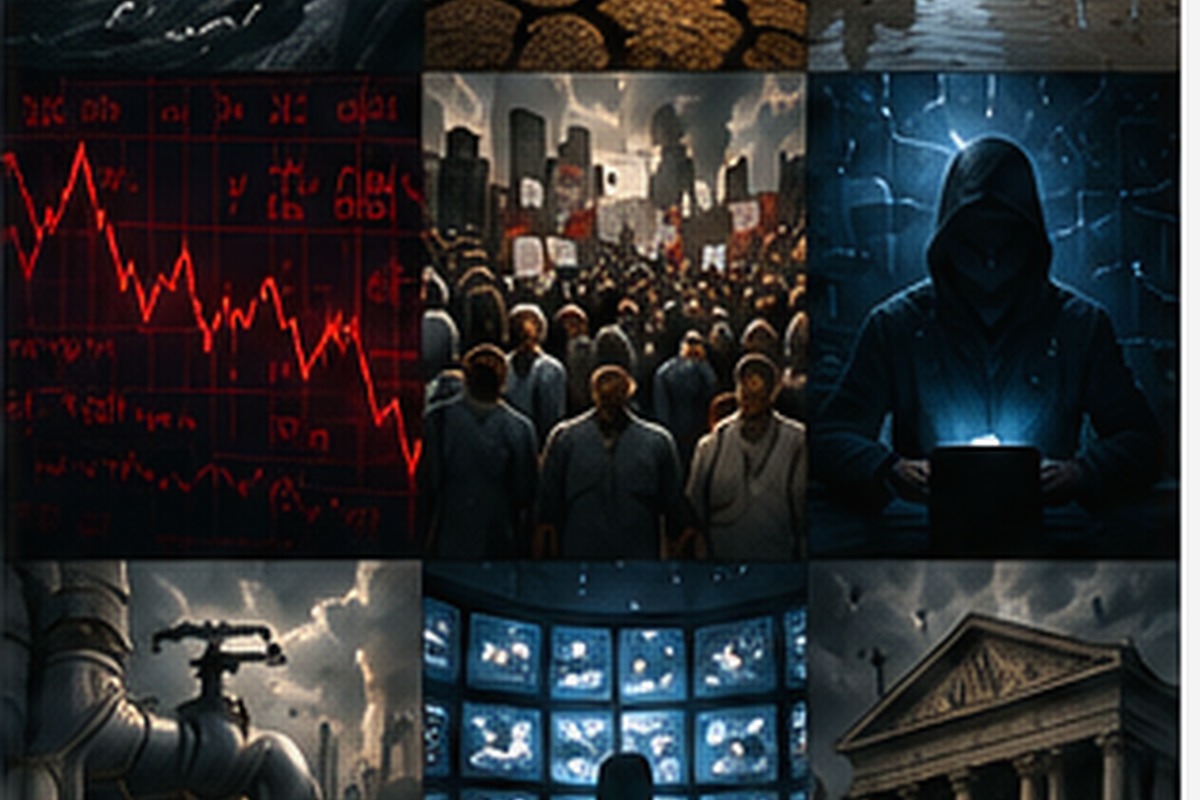
3. The Major Drivers of the Great Reckoning
Ecological overshoot
Human economies depend on ecological regeneration, stable climate systems, fertile soils, freshwater, forests, oceans, biodiversity, and material resources. Persistent overshoot draws down stocks and erodes the resilience of the systems on which civilization depends.
Climate destabilization
Rising temperatures and associated extremes can intensify heat stress, fires, floods, droughts, crop losses, water insecurity, migration, infrastructure damage, insurance withdrawal, fiscal stress, and political instability.
Resource and energy constraints
Modern civilization was built using extraordinarily large flows of concentrated energy and materials. Declining resource quality, infrastructure costs, geopolitical concentration, and ecological constraints can make maintaining existing complexity increasingly expensive.
Institutional dysfunction and capture
Institutions can be weakened when powerful actors capture benefits while shifting costs onto the public, future generations, ecosystems, or less powerful groups. When consequences are not captured by decision-makers, destructive behavior can remain locally rational while becoming collectively disastrous.
Economic fragility
Debt dependence, inequality, financial leverage, long supply chains, high infrastructure costs, and growth-dependent institutions can convert physical disruptions into economic and political shocks.
Information disorder
Misinformation, propaganda, manipulation, fragmented media, algorithmic incentives, and declining trust can damage a society's ability to perceive threats accurately and coordinate responses.
Geopolitical competition
Scarcity, strategic rivalry, conflict, migration, and security dilemmas can redirect resources from adaptation toward coercion and competition, while undermining international cooperation precisely when cooperation becomes more necessary.
Rapid technological change
AI, biotechnology, cyber systems, autonomous weapons, surveillance, and other technologies can improve adaptive capacity while also creating new systemic risks, power imbalances, and opportunities for misuse.

4. Why the Great Reckoning Is More Than a List of Problems
A polycrisis becomes especially dangerous when problems form feedback loops. Climate impacts can reduce crop yields. Food-price shocks can increase political instability. Political instability can weaken environmental policy. Weak policy can permit greater ecological damage, which intensifies climate and resource pressures. The loop closes.
General systems theory reminds us that outcomes depend on relationships, feedback, delays, thresholds, bottlenecks, information flows, and adaptation. Dialectical metasystemic thinking (DMAP) adds another necessary warning: any apparently stable condition contains tensions, competing tendencies, changing contexts, processes, and transformations over time.
Civilization is not a linear row of dominoes. It is a nested network of living dependent and interdependent, technological, institutional, ecological, and cultural systems whose failures and adaptations can propagate in several directions at once. In the image below, you can see the dependence and interdependence of the various levels and items within those levels.
The governance overshoot problem
Overshoot is not merely ecological. Governance systems can also accumulate obligations, complexity, security costs, maintenance backlogs, debt, bureaucracy, and control mechanisms faster than the economic and social surplus supporting them. When returns to additional complexity decline, societies face a difficult choice: simplify intelligently or suffer simplification through breakdown.

5. A Practical Risk-Window Framework
Exact dates should never be treated as prophecy. They are planning windows for matching actions to rising risk. Different hazards operate on different clocks, and reasonable analysts will disagree about their severity and timing.
| Planning window | What deserves attention | Priority response |
|---|---|---|
| 2026-2032 | Rapid climate-risk growth, insurance and infrastructure stresses, food/water volatility, geopolitical fragmentation, AI disruption, rising disaster costs, and closing windows for low-cost prevention. | Immediate emissions reduction, household and community resilience, infrastructure protection, risk education, institutional reform, and early relocation planning where necessary. |
| 2033-2045 | Potential compounding of physical climate impacts, ecological degradation, migration pressures, public-finance strain, resource constraints, and political instability. | Deep adaptation, resilient food/water/energy systems, regional cooperation, managed simplification, commons protection, knowledge preservation, and stronger anti-capture governance. |
| 2045-2050+ | Longer-run consequences of cumulative warming, ecosystem losses, resource depletion, demographic shifts, infrastructure choices, and whether institutional learning succeeded or failed. | Preserve adaptive capacity, restore ecosystems, maintain critical knowledge and institutions, reduce throughput where necessary, and expand successful cooperative models. |
These windows are intentionally broad. Their purpose is to prevent the classic civilizational management strategy of waiting until a foreseeable emergency has become a cataclysmic surprise.

6. The Great Reckoning Is Not Simply "Collapse"
Collapse research is relevant, but the Great Reckoning framework is broader. Civilizations can respond to stress through mixtures of collapse, simplification, reform, substitution, technological innovation, migration, decentralization, authoritarian control, cooperation, or regeneration.
Historical collapse is also rarely uniform. State capacity may decline while local communities remain functional. A political order may fail while scientific or cultural institutions survive. One region may experience severe breakdown while another receives migrants and gains economic activity.
The both-and principle
Our analysis deliberately rejects false either/or choices such as collapse or progress, technology or conservation, mitigation or adaptation, and local resilience or global cooperation. Under severe systemic stress, viable strategies will often require both-and combinations: reduce danger and prepare for impacts; preserve sophisticated capabilities and simplify unnecessary overhead; strengthen communities and maintain higher-level coordination.
7. What Can Still Be Done During the Great Reckoning?
The purpose of this framework is not to provide a more sophisticated vocabulary for despair. It is to improve decisions.
- Reduce the drivers. Lower greenhouse-gas emissions, halt ecological destruction, restore ecosystems, reduce pollution, and move economic activity toward levels that can remain within ecological limits.
- Prepare for now unavoidable consequences. Strengthen food, water, energy, health, housing, disaster, and migration resilience.
- Improve collective intelligence. Teach rationality and logic, evidence evaluation, probabilistic reasoning, systems thinking, dialectical thinking, misinformation resistance, and decision-making under uncertainty.
- Align incentives with consequences. Improve consequence capture so decision-makers cannot privatize benefits while socializing ecological, financial, or political costs.
- Suppress deliberate free-riding. Cooperation fails when exploitation consistently pays better than contribution. Institutions need transparent rules, verification, proportionate enforcement, appeal, and anti-capture safeguards.
- Protect commons. Water, atmosphere, soils, biodiversity, knowledge, public institutions, and information environments require governance designed around long-term shared benefit.
- Simplify intelligently. Preserve high-value complexity while removing expensive, brittle, parasitic, or low-return systems before scarcity makes those choices involuntary.
- Build multiple scales of cooperation. Households, neighborhoods, cities, regions, nations, and international institutions solve different parts of the problem. No single scale can substitute for all the others.
Practical hope is not confidence that everything will work out. It is the decision to reduce preventable harm, preserve what matters, and enlarge the range of good futures still physically and socially possible.

8. AI Prompts for Testing and Applying the Great Reckoning Framework
Use AI as a research assistant, not an oracle with better typography. Ask it to expose disagreements, evidence gaps, and alternative explanations. We provide AI prompts to help you determine the usefulness and the validity of the information we are providing.
Prompt 1: "Analyze the Great Reckoning framework using current research on polycrisis, ecological overshoot, climate risk, resource constraints, governance failure, economic fragility, and technological disruption. Separate strong evidence, contested evidence, and speculation."
Prompt 2: "Red-team the claim that modern civilization is entering a prolonged period of systemic reckoning. Find the strongest evidence against the thesis, identify historical counterexamples, and state what observations would falsify or substantially weaken it."
Prompt 3: "Map feedback loops among climate change, biodiversity loss, food insecurity, migration, inequality, political instability, misinformation, geopolitical conflict, and public-finance stress. Identify leverage points that reduce several risks simultaneously."
Prompt 4: "Apply ecological overshoot and consequence-capture analysis to my city, organization, or industry. Which costs are being externalized, who benefits, who bears the consequences, and what governance changes could improve alignment?"
9. Frequently Asked Questions
Is the Great Reckoning another word for the polycrisis?
No. Polycrisis primarily describes interacting multiple global crises. The Great Reckoning describes the broader historical period in which those interacting crises, their deeper causes, ecological limits, and accumulated consequences increasingly have to be confronted.
Is the Great Reckoning the same as the metacrisis?
No. Metacrisis emphasizes foundational cultural, institutional, cognitive, and value structures that generate crises. It is an important explanation for why the Reckoning occurs, but the Reckoning also includes biophysical constraints, material consequences, and societal responses.
Does the Great Reckoning mean civilization will collapse?
Not necessarily. Partial collapse is one possible outcome in some systems or regions. Adaptation, simplification, reform, technological substitution, and regeneration are also possible. The framework is deliberately probabilistic and multi-pathway.
Why put ecological overshoot at the center?
Because economies and political systems ultimately operate and are nested inside ecological systems. A society can postpone financial accounting more easily than it can indefinitely postpone soil loss, depleted aquifers, damaged ecosystems, material scarcity, or accumulated greenhouse gases.
What comes after the Great Reckoning?
There is no guaranteed "after." The Great Reckoning and Great Rebirth can overlap. Regenerative institutions may emerge while other systems are deteriorating. Our name for the constructive, long-term process of building better-adapted civilization is Humanity's Great Rebirth.
Why is this nonprofit organization called the Way of the Universe, and how is it practiced?
Values tell us what matters. Principles guide our actions. Through repeated, thoughtful practice, they help us develop virtues—dependable qualities such as honesty, fairness, and compassion.
The name Way of the Universe reflects an important connection between many values and principles we teach and recurring evolutionary patterns that also support life’s continuation and renewal. These connections between traditional values and principles and recurring evolutionary patterns can strengthen practical guidance, practice, and action under suitable conditions. But evolutionary patterns do not guarantee results or make something morally right simply because it occurs in nature and appears to forward the cycle of life.
The Way of the Universe's core educational work is helping people think rationally, analyze wisely, and choose and live by life-affirming values and principles, using evidence and thoughtful action to build better lives, communities, corporations, and nations. One practices this new philosophy by choosing from the many life-affirming values and principles we teach, putting them into action, checking their consequences, and using them to improve how we live and cooperate.

10. Glossary
11. References and Further Reading
- Cascade Institute — research and frameworks for global systemic risks and polycrisis analysis.
- Metacrisis.info — introduction to metacrisis and its relationship to polycrisis.
- The Great Simplification — Nate Hagens and the Institute for the Study of Energy & Our Future.
- Club of Rome: The Planetary Emergency Plan.
- Global Footprint Network: Earth Overshoot Day.
- Global Footprint Network: Ecological Footprint.
- Stockholm Resilience Centre: Planetary Boundaries.
- United Nations Environment Programme — climate, biodiversity, pollution, and the triple planetary crisis.
- Post Carbon Institute — resilience, energy, limits, and societal transition.
- Great Transition Initiative — long-term civilizational transition toward a just and sustainable planetary society.
12. Where This Leads
Diagnosis is necessary, but diagnosis without transition planning becomes an unusually elaborate way to stand beside a fire and describe the smoke. The next page examines how societies can move through the Reckoning without pretending that either collapse or miraculous rescue is predetermined.
Continue to From the Great Reckoning to the Great Rebirth, our transition map for preserving what works, reducing suffering, simplifying where necessary, and creating the conditions from which better institutions and cultures can grow.
Showing 1 reaction