

10.31.26. Draft in progress.
Introduction
Who or what created the universe? Why is there anything at all? Did the cosmos begin, has it always existed, or does reality have a source beyond space and time? These are among humanity's most persistent and intimate questions. They have inspired scientific discoveries, religions, philosophical traditions, and personal quests for meaning.
We may never reach a perfect or final answer. Yet an honest, carefully examined working answer can still bring stability, wonder, a stronger sense of identity, and a richer sense of purpose. The aim is not to confuse what comforts us with what has been demonstrated. It is to pursue both truth and a meaningful life without pretending they are the same thing.
Philosophy is a lifelong practice. Through inquiry, lived experience, dialogue, self-correction, and new evidence, we can continually improve our answers, clarify our values, and discover aspects of our identity we had not previously understood. A useful philosophy is not a frozen collection of opinions. It is a developing capacity to think and live more wisely.
This guide examines 100 proposals across science, philosophy, religion, and speculation. They are not 100 independent, equally supported scientific theories. Some are closely related variants, some are explanations of cosmic development rather than creation, and others are spiritual or philosophical interpretations. Keeping these differences visible is essential.

The hot Big Bang describes the early evolution of the observable universe, not a demonstrated origin from absolute nothingness.
The initial question mark is unknown, not a verified prior event.
Quick navigation
1-12: Scientific models of the early universe
13-25: Pre-Big Bang, bounce, and cyclic proposals
26-35: Multiverse and higher-dimensional proposals
36-50: Classical and modern metaphysical explanations
51-60: Consciousness, information, and mathematics
61-75: Creator-centered religious traditions
76-85: Non-creator and emanation traditions
86-92: Artificial creation and simulation
93-100: Further logical and epistemological possibilities
How to evaluate claims
Comparison and leading candidates
AI and existential questions
Conclusion
FAQ
Glossary
Sources
How these 100 explanations are evaluated
Each entry identifies its original or distinctive idea, leading proponents, principal argument or evidence, strongest objection, empirical testability, current standing, and whether it answers the ultimate origin question or merely moves that question elsewhere. “Original idea” here means a defining contribution, not a claim that no predecessor ever proposed something similar.
Evidence standard: “Established” means a model is strongly supported within its stated scope, not that it answers everything. “Speculative” means a proposal has not been confirmed. “Not scientifically testable” does not by itself mean false; it means the proposal cannot presently be adjudicated by empirical scientific methods. No numerical confidence score is assigned where no defensible calibrated probability exists.
Two different questions: How did the hot, expanding universe develop? And why does any reality exist at all? The Big Bang addresses much of the first question, but it does not by itself answer the second.
1-12. Scientific models of the early universe

Schematic comparison of hot Big Bang, bounce, cyclic, and eternal inflation models. Only the hot early expansion has strong direct observational support; a hot Big Bang does not necessarily imply an absolute beginning.
1. Hot Big Bang
Original or defining idea: Observable cosmos evolved from a hot dense state.
Proponents or tradition: Lemaitre; Gamow.
Supporting argument or evidence: CMB, expansion, primordial elements.
Principal objection or limitation: Does not identify ultimate origin.
Empirical testability: High.
Current standing: Established early-universe framework.
Does it explain ultimate existence?: Defers ultimate cause.
2. Initial singularity
Original or defining idea: Classical equations imply a past boundary.
Proponents or tradition: Hawking; Penrose.
Supporting argument or evidence: Classical singularity theorems.
Principal objection or limitation: Quantum gravity likely changes extrapolation.
Empirical testability: Indirect.
Current standing: Mathematical limit, not confirmed event.
Does it explain ultimate existence?: Does not settle origin.
3. Cosmic inflation
Original or defining idea: Early accelerated expansion shaped cosmic structure.
Proponents or tradition: Guth; Linde.
Supporting argument or evidence: Flatness and fluctuation patterns.
Principal objection or limitation: Mechanism and initial conditions unknown.
Empirical testability: Partial.
Current standing: Active, unconfirmed mechanism.
Does it explain ultimate existence?: Defers cause.
4. Quantum creation from nothing
Original or defining idea: Universe emerges through quantum cosmology.
Proponents or tradition: Various quantum cosmologists.
Supporting argument or evidence: Possible formal quantum descriptions.
Principal objection or limitation: Quantum nothing may assume laws.
Empirical testability: Unclear.
Current standing: Speculative.
Does it explain ultimate existence?: Defers laws.
5. Vilenkin tunneling
Original or defining idea: Universe tunnels from no classical spacetime.
Proponents or tradition: Alexander Vilenkin.
Supporting argument or evidence: Quantum tunneling model.
Principal objection or limitation: Boundary conditions remain assumed.
Empirical testability: Indirect.
Current standing: Speculative.
Does it explain ultimate existence?: Defers quantum framework.
6. Hartle-Hawking no-boundary
Original or defining idea: Earliest geometry has no ordinary time edge.
Proponents or tradition: Hartle; Hawking.
Supporting argument or evidence: Euclidean path-integral proposal.
Principal objection or limitation: Measure and interpretation disputed.
Empirical testability: Indirect.
Current standing: Speculative.
Does it explain ultimate existence?: Reframes first moment.
7. Quantum vacuum fluctuation
Original or defining idea: Universe arises from vacuum dynamics.
Proponents or tradition: Tryon and successors.
Supporting argument or evidence: Quantum vacuum phenomena exist.
Principal objection or limitation: Vacuum is not absolute nothing.
Empirical testability: Unclear.
Current standing: Speculative extrapolation.
Does it explain ultimate existence?: Defers vacuum origin.
8. Eternal inflation
Original or defining idea: Inflating spacetime keeps producing regions.
Proponents or tradition: Linde; Vilenkin.
Supporting argument or evidence: Some inflationary potentials permit it.
Principal objection or limitation: Measure problem and past incompleteness.
Empirical testability: Very difficult.
Current standing: Speculative.
Does it explain ultimate existence?: Defers underlying spacetime.
9. Bubble universe formation
Original or defining idea: Our region nucleated within inflation.
Proponents or tradition: Inflationary cosmologists.
Supporting argument or evidence: Vacuum transitions are mathematically modeled.
Principal objection or limitation: No verified parent region.
Empirical testability: Very difficult.
Current standing: Speculative.
Does it explain ultimate existence?: Defers parent reality.
10. False vacuum decay
Original or defining idea: A vacuum transition creates new cosmic conditions.
Proponents or tradition: Coleman; De Luccia.
Supporting argument or evidence: Quantum field theory permits decay.
Principal objection or limitation: Our origin not demonstrated.
Empirical testability: Partial in principle.
Current standing: Speculative cosmological application.
Does it explain ultimate existence?: Defers vacuum.
11. Chaotic inflation
Original or defining idea: Different field conditions seed expanding regions.
Proponents or tradition: Andrei Linde.
Supporting argument or evidence: Inflationary field models.
Principal objection or limitation: Specific potentials unverified.
Empirical testability: Partial.
Current standing: Model family, unconfirmed.
Does it explain ultimate existence?: Defers field origin.
12. Self-reproducing inflation
Original or defining idea: Inflation generates new inflationary domains.
Proponents or tradition: Linde.
Supporting argument or evidence: Stochastic inflation calculations.
Principal objection or limitation: Measure and observability problems.
Empirical testability: Very difficult.
Current standing: Speculative.
Does it explain ultimate existence?: Defers initial framework.
13-25. Pre-Big Bang, bounce, and cyclic proposals
13. Big Bounce
Original or defining idea: A contracting cosmos rebounded into expansion.
Proponents or tradition: Various.
Supporting argument or evidence: Avoids singularity in models.
Principal objection or limitation: No observed pre-bounce signal.
Empirical testability: Potentially.
Current standing: Speculative.
Does it explain ultimate existence?: Defers cycle origin.
14. Loop quantum cosmology
Original or defining idea: Quantum geometry replaces singularity with bounce.
Proponents or tradition: Bojowald; Ashtekar.
Supporting argument or evidence: Quantum-gravity-inspired equations.
Principal objection or limitation: Reduced models may not represent full theory.
Empirical testability: Potentially.
Current standing: Research program.
Does it explain ultimate existence?: Defers quantum laws.
15. Cyclic universe
Original or defining idea: Cosmos undergoes repeated phases.
Proponents or tradition: Various.
Supporting argument or evidence: Some models avoid unique beginning.
Principal objection or limitation: Entropy and dynamics difficult.
Empirical testability: Potentially.
Current standing: Speculative.
Does it explain ultimate existence?: May defer cycles.
16. Ekpyrotic cosmology
Original or defining idea: Slow contraction precedes hot expansion.
Proponents or tradition: Khoury; Steinhardt et al..
Supporting argument or evidence: Possible alternatives to inflation.
Principal objection or limitation: Bounce and perturbations challenging.
Empirical testability: Potentially.
Current standing: Speculative.
Does it explain ultimate existence?: Defers prehistory.
17. Steinhardt-Turok cyclic
Original or defining idea: Scalar-field or brane dynamics repeat epochs.
Proponents or tradition: Steinhardt; Turok.
Supporting argument or evidence: Constructed cyclic models.
Principal objection or limitation: Unconfirmed mechanism.
Empirical testability: Potentially.
Current standing: Speculative.
Does it explain ultimate existence?: Defers laws.
18. Conformal cyclic cosmology
Original or defining idea: Future aeon maps to next aeon.
Proponents or tradition: Roger Penrose.
Supporting argument or evidence: Conformal mathematical construction.
Principal objection or limitation: Claimed CMB signatures contested.
Empirical testability: Potentially.
Current standing: Speculative.
Does it explain ultimate existence?: Defers aeon structure.
19. Oscillating universe
Original or defining idea: Expansion reverses to contraction repeatedly.
Proponents or tradition: Tolman and others.
Supporting argument or evidence: Simple gravitational possibility.
Principal objection or limitation: Accelerating expansion and entropy problems.
Empirical testability: Potentially.
Current standing: Disfavored simple forms.
Does it explain ultimate existence?: Defers first cycle.
20. Black-hole cosmology
Original or defining idea: Our cosmos emerged inside a black hole.
Proponents or tradition: Various.
Supporting argument or evidence: Some speculative spacetime extensions.
Principal objection or limitation: No direct observational evidence.
Empirical testability: Unclear.
Current standing: Highly speculative.
Does it explain ultimate existence?: Defers parent universe.
21. Cosmological natural selection
Original or defining idea: Black holes spawn varied daughter universes.
Proponents or tradition: Lee Smolin.
Supporting argument or evidence: Evolutionary analogy yields proposed predictions.
Principal objection or limitation: Reproduction mechanism unverified.
Empirical testability: Limited.
Current standing: Speculative.
Does it explain ultimate existence?: Defers first universe.
22. String gas cosmology
Original or defining idea: String thermodynamics shapes early cosmos.
Proponents or tradition: Brandenberger; Vafa.
Supporting argument or evidence: String-theoretic constructions.
Principal objection or limitation: String theory unconfirmed.
Empirical testability: Potentially.
Current standing: Speculative.
Does it explain ultimate existence?: Defers strings.
23. Pre-Big Bang string cosmology
Original or defining idea: String dynamics preceded hot phase.
Proponents or tradition: Gasperini; Veneziano.
Supporting argument or evidence: Duality-inspired models.
Principal objection or limitation: Graceful transition unresolved.
Empirical testability: Potentially.
Current standing: Speculative.
Does it explain ultimate existence?: Defers underlying theory.
24. Emergent universe
Original or defining idea: Long-lived phase precedes expansion.
Proponents or tradition: Ellis; Maartens and others.
Supporting argument or evidence: Models evade finite-age start.
Principal objection or limitation: Stability and viability debated.
Empirical testability: Potentially.
Current standing: Speculative.
Does it explain ultimate existence?: Defers eternal state.
25. Eternal static precursor
Original or defining idea: Quasi-static state becomes expanding cosmos.
Proponents or tradition: Various.
Supporting argument or evidence: Some solutions permit precursor.
Principal objection or limitation: Instability and initial state unexplained.
Empirical testability: Potentially.
Current standing: Speculative.
Does it explain ultimate existence?: Defers precursor.
26-35. Multiverse and higher-dimensional proposals

Conceptual representation of bubble universes; other universes have not been observationally established.
26. Inflationary multiverse
Original or defining idea: Separate inflationary regions host universes.
Proponents or tradition: Linde and others.
Supporting argument or evidence: Some eternal inflation models imply it.
Principal objection or limitation: No confirmed other universes.
Empirical testability: Very difficult.
Current standing: Speculative.
Does it explain ultimate existence?: Defers multiverse.
27. String landscape multiverse
Original or defining idea: Many string vacua realize different physics.
Proponents or tradition: String theorists.
Supporting argument or evidence: Large solution landscape.
Principal objection or limitation: No confirmed string vacuum.
Empirical testability: Very difficult.
Current standing: Speculative.
Does it explain ultimate existence?: Defers landscape.
28. Brane-world cosmology
Original or defining idea: Our world lies on a higher-dimensional brane.
Proponents or tradition: Randall; Sundrum and others.
Supporting argument or evidence: Higher-dimensional mathematical models.
Principal objection or limitation: Extra dimensions not established.
Empirical testability: Potentially.
Current standing: Speculative.
Does it explain ultimate existence?: Defers bulk reality.
29. Brane collision origin
Original or defining idea: Brane interactions trigger hot phase.
Proponents or tradition: Ekpyrotic theorists.
Supporting argument or evidence: Constructed collision scenarios.
Principal objection or limitation: No observed collision evidence.
Empirical testability: Potentially.
Current standing: Speculative.
Does it explain ultimate existence?: Defers branes.
30. Many-worlds interpretation
Original or defining idea: Quantum branches describe multiple outcomes.
Proponents or tradition: Hugh Everett.
Supporting argument or evidence: Unitary quantum dynamics.
Principal objection or limitation: Probability interpretation contested.
Empirical testability: Interpretation-dependent.
Current standing: Quantum interpretation, not origin theory.
Does it explain ultimate existence?: Does not explain origin.
31. Mathematical universe hypothesis
Original or defining idea: Reality is a mathematical structure.
Proponents or tradition: Max Tegmark.
Supporting argument or evidence: Mathematics describes physics powerfully.
Principal objection or limitation: Description does not imply existence.
Empirical testability: Unclear.
Current standing: Metaphysical conjecture.
Does it explain ultimate existence?: Claims foundation, not demonstrated.
32. Level IV multiverse
Original or defining idea: All mathematical structures physically exist.
Proponents or tradition: Max Tegmark.
Supporting argument or evidence: Radical mathematical realism.
Principal objection or limitation: Unfalsifiable breadth.
Empirical testability: Very difficult.
Current standing: Highly speculative.
Does it explain ultimate existence?: Asserts rather than explains existence.
33. Baby universe formation
Original or defining idea: New spacetime regions bud from parent cosmos.
Proponents or tradition: Various.
Supporting argument or evidence: Quantum-gravity scenarios.
Principal objection or limitation: No confirmed mechanism.
Empirical testability: Unclear.
Current standing: Speculative.
Does it explain ultimate existence?: Defers parent.
34. Black-hole universe reproduction
Original or defining idea: Black holes generate daughter universes.
Proponents or tradition: Smolin and related proposals.
Supporting argument or evidence: Possible speculative spacetime links.
Principal objection or limitation: No demonstrated offspring.
Empirical testability: Unclear.
Current standing: Speculative.
Does it explain ultimate existence?: Defers lineage.
35. Quantum cosmological branching
Original or defining idea: Quantum cosmology includes divergent histories.
Proponents or tradition: Decoherent histories researchers.
Supporting argument or evidence: Wavefunction approaches.
Principal objection or limitation: Interpretation and measure unsettled.
Empirical testability: Indirect.
Current standing: Speculative.
Does it explain ultimate existence?: Defers wavefunction.
36-50. Classical and modern metaphysical explanations

Different philosophical accounts of ultimate reality and causation; these are not interchangeable or all empirically testable.
36. Aristotle's Unmoved Mover
Original or defining idea: Ultimate actuality explains motion.
Proponents or tradition: Aristotle.
Supporting argument or evidence: Argument from change and actuality.
Principal objection or limitation: Applicability to modern cosmos disputed.
Empirical testability: No direct test.
Current standing: Classical metaphysics.
Does it explain ultimate existence?: Proposes necessary terminus.
37. Plato's Demiurge
Original or defining idea: Intelligence orders preexisting cosmos.
Proponents or tradition: Plato.
Supporting argument or evidence: Teleological account of order.
Principal objection or limitation: Does not explain preexisting material.
Empirical testability: No.
Current standing: Philosophical myth/model.
Does it explain ultimate existence?: Defers material origin.
38. Plotinus's emanationism
Original or defining idea: Reality emanates from the One.
Proponents or tradition: Plotinus.
Supporting argument or evidence: Hierarchy of dependence.
Principal objection or limitation: No empirical demonstration.
Empirical testability: No.
Current standing: Metaphysical system.
Does it explain ultimate existence?: One treated as ultimate.
39. First Cause argument
Original or defining idea: Causal series needs an uncaused foundation.
Proponents or tradition: Aquinas and others.
Supporting argument or evidence: Arguments against dependent regress.
Principal objection or limitation: Infinite regress may be possible.
Empirical testability: No direct test.
Current standing: Contested philosophy.
Does it explain ultimate existence?: Posits ultimate cause.
40. Kalam cosmological argument
Original or defining idea: A beginning universe has a cause.
Proponents or tradition: Al-Ghazali; Craig.
Supporting argument or evidence: Causal intuition and beginning arguments.
Principal objection or limitation: Causality at spacetime origin disputed.
Empirical testability: No direct test.
Current standing: Contested philosophy.
Does it explain ultimate existence?: Cause's nature unresolved.
41. Principle of Sufficient Reason
Original or defining idea: Contingent cosmos requires explanation.
Proponents or tradition: Leibniz.
Supporting argument or evidence: Explanatory demand for contingent facts.
Principal objection or limitation: Principle itself debated.
Empirical testability: No.
Current standing: Contested philosophy.
Does it explain ultimate existence?: Posits sufficient reason.
42. Necessary existence
Original or defining idea: Ultimate reality exists in every possible world.
Proponents or tradition: Various metaphysicians.
Supporting argument or evidence: Modal arguments.
Principal objection or limitation: Necessity not established.
Empirical testability: No.
Current standing: Metaphysical possibility.
Does it explain ultimate existence?: Aims to stop regress.
43. Spinoza's substance monism
Original or defining idea: God or Nature is self-existing substance.
Proponents or tradition: Baruch Spinoza.
Supporting argument or evidence: Unified metaphysical account.
Principal objection or limitation: Unique necessary substance disputed.
Empirical testability: No.
Current standing: Philosophical system.
Does it explain ultimate existence?: Identifies ultimate with reality.
44. Brute fact
Original or defining idea: Existence has no deeper explanation.
Proponents or tradition: Russell and others.
Supporting argument or evidence: Avoids unsupported extra entities.
Principal objection or limitation: Leaves why-question unanswered.
Empirical testability: No.
Current standing: Live philosophical position.
Does it explain ultimate existence?: Stops explanation by stipulation.
45. Infinite regress
Original or defining idea: Causes or explanations have no first term.
Proponents or tradition: Various.
Supporting argument or evidence: Infinite sequences may be coherent.
Principal objection or limitation: Whether actual causal infinity works disputed.
Empirical testability: No direct test.
Current standing: Live possibility.
Does it explain ultimate existence?: No final cause.
46. Eternal universe philosophy
Original or defining idea: Reality never began.
Proponents or tradition: Aristotle and others.
Supporting argument or evidence: Avoids creation event.
Principal objection or limitation: Eternity alone does not explain existence.
Empirical testability: No direct test.
Current standing: Metaphysical possibility.
Does it explain ultimate existence?: Defers why eternal.
47. Kant's limits of reason
Original or defining idea: Origin may exceed valid human inference.
Proponents or tradition: Immanuel Kant.
Supporting argument or evidence: Antinomies of pure reason.
Principal objection or limitation: Limits themselves debated.
Empirical testability: No.
Current standing: Epistemological critique.
Does it explain ultimate existence?: Suspends ultimate answer.
48. Hegelian absolute idealism
Original or defining idea: Reality unfolds as rational whole.
Proponents or tradition: G. W. F. Hegel.
Supporting argument or evidence: Systematic account of historical intelligibility.
Principal objection or limitation: Highly disputed metaphysics.
Empirical testability: No.
Current standing: Philosophical system.
Does it explain ultimate existence?: Ultimate rational whole asserted.
49. Process philosophy
Original or defining idea: Events and becoming are fundamental.
Proponents or tradition: Whitehead; Hartshorne.
Supporting argument or evidence: Explains dynamic relations.
Principal objection or limitation: No unique creation mechanism.
Empirical testability: No direct test.
Current standing: Metaphysical framework.
Does it explain ultimate existence?: Reframes substance question.
50. Dialectical cosmology
Original or defining idea: Reality develops through systemic contradictions.
Proponents or tradition: Hegelian and dialectical thinkers.
Supporting argument or evidence: Highlights change and interdependence.
Principal objection or limitation: Not a predictive origin model.
Empirical testability: No direct test.
Current standing: Interpretive framework.
Does it explain ultimate existence?: Does not establish beginning.
51-60. Consciousness, information, and mathematic
51. Objective idealism
Original or defining idea: Mind-like reality is fundamental.
Proponents or tradition: Schelling and others.
Supporting argument or evidence: Accounts for intelligibility.
Principal objection or limitation: Physical emergence unexplained.
Empirical testability: No.
Current standing: Metaphysical position.
Does it explain ultimate existence?: Mind-like foundation posited.
52. Absolute idealism
Original or defining idea: Reality forms one encompassing rational whole.
Proponents or tradition: Bradley; Hegel.
Supporting argument or evidence: Coherence and unity arguments.
Principal objection or limitation: Problem of individual experience.
Empirical testability: No.
Current standing: Metaphysical position.
Does it explain ultimate existence?: Whole treated as ultimate.
53. Cosmopsychism
Original or defining idea: Cosmos has fundamental consciousness.
Proponents or tradition: Contemporary philosophers.
Supporting argument or evidence: Attempts to address consciousness.
Principal objection or limitation: No evidence of cosmic subject.
Empirical testability: No clear test.
Current standing: Speculative philosophy.
Does it explain ultimate existence?: Does not explain existence.
54. Panpsychism
Original or defining idea: Experience is pervasive and fundamental.
Proponents or tradition: Strawson; Goff and others.
Supporting argument or evidence: Avoids emergence from wholly nonexperiential matter.
Principal objection or limitation: Combination problem.
Empirical testability: No clear test.
Current standing: Contested philosophy.
Does it explain ultimate existence?: Not an origin explanation.
55. Information-first ontology
Original or defining idea: Information is ontologically primary.
Proponents or tradition: Wheeler-inspired thinkers.
Supporting argument or evidence: Information central to physics.
Principal objection or limitation: Information may require physical instantiation.
Empirical testability: Unclear.
Current standing: Speculative framework.
Does it explain ultimate existence?: Defers information origin.
56. Digital physics
Original or defining idea: Physical reality is discrete computation-like structure.
Proponents or tradition: Zuse; Fredkin.
Supporting argument or evidence: Computational models.
Principal objection or limitation: No demonstrated universal discrete substrate.
Empirical testability: Potentially.
Current standing: Speculative.
Does it explain ultimate existence?: Defers rules.
57. Computational universe
Original or defining idea: Cosmos evolves by computational rules.
Proponents or tradition: Wolfram and others.
Supporting argument or evidence: Simple rules can yield complexity.
Principal objection or limitation: No verified universe-generating rule.
Empirical testability: Potentially.
Current standing: Speculative.
Does it explain ultimate existence?: Defers computation.
58. Mathematical necessity
Original or defining idea: Mathematics necessitates reality.
Proponents or tradition: Mathematical realists.
Supporting argument or evidence: Logical consistency.
Principal objection or limitation: Existence does not follow from consistency.
Empirical testability: No.
Current standing: Metaphysical conjecture.
Does it explain ultimate existence?: Claims necessity.
59. Participatory universe
Original or defining idea: Observation participates in physical reality.
Proponents or tradition: John Wheeler.
Supporting argument or evidence: Quantum measurement puzzles.
Principal objection or limitation: Does not show observers create cosmos.
Empirical testability: Unclear.
Current standing: Interpretive speculation.
Does it explain ultimate existence?: Does not settle origin.
60. Consciousness-first creation
Original or defining idea: Primordial consciousness generates matter.
Proponents or tradition: Idealist traditions.
Supporting argument or evidence: First-person experience is undeniable.
Principal objection or limitation: Mechanism and independent evidence lacking.
Empirical testability: No established test.
Current standing: Metaphysical hypothesis.
Does it explain ultimate existence?: Defers consciousness source.
61-75. Creator-centered religious traditions

Broad families of creation and ultimate-source beliefs; traditions contain considerable internal diversity.
61. Judaism
Original or defining idea: God creates heaven and earth.
Proponents or tradition: Jewish scriptures and traditions.
Supporting argument or evidence: Scripture, theology, lived faith.
Principal objection or limitation: No independent empirical proof of creator.
Empirical testability: Not scientifically testable as stated.
Current standing: Religious doctrine.
Does it explain ultimate existence?: God taken as ultimate.
62. Christianity
Original or defining idea: God creates and sustains all.
Proponents or tradition: Christian traditions.
Supporting argument or evidence: Scripture and theological arguments.
Principal objection or limitation: Competing faiths and evil/suffering objections.
Empirical testability: Not scientifically testable as stated.
Current standing: Religious doctrine.
Does it explain ultimate existence?: God taken as ultimate.
63. Islam
Original or defining idea: Allah creates and sustains cosmos.
Proponents or tradition: Quran; Islamic theology.
Supporting argument or evidence: Revelation and philosophical arguments.
Principal objection or limitation: Creator not independently verified.
Empirical testability: Not scientifically testable as stated.
Current standing: Religious doctrine.
Does it explain ultimate existence?: Allah taken as ultimate.
64. Bahai Faith
Original or defining idea: God is ultimate source of creation.
Proponents or tradition: Bahaullah and Bahai teachings.
Supporting argument or evidence: Revelation and spiritual coherence.
Principal objection or limitation: Not independently demonstrable.
Empirical testability: No direct test.
Current standing: Religious doctrine.
Does it explain ultimate existence?: God taken as ultimate.
65. Sikhism
Original or defining idea: Ik Onkar is source and sustainer.
Proponents or tradition: Guru Granth Sahib.
Supporting argument or evidence: Scriptural and devotional tradition.
Principal objection or limitation: Not scientifically verified.
Empirical testability: No direct test.
Current standing: Religious doctrine.
Does it explain ultimate existence?: Ultimate divine reality.
66. Vaishnavism
Original or defining idea: Vishnu or Krishna grounds cosmic creation.
Proponents or tradition: Vaishnava scriptures.
Supporting argument or evidence: Theological tradition and practice.
Principal objection or limitation: No independent empirical proof.
Empirical testability: No direct test.
Current standing: Religious cosmology.
Does it explain ultimate existence?: Divinity ultimate.
67. Shaivism
Original or defining idea: Shiva grounds creation and transformation.
Proponents or tradition: Shaiva traditions.
Supporting argument or evidence: Sacred texts and spiritual practice.
Principal objection or limitation: Diverse incompatible interpretations.
Empirical testability: No direct test.
Current standing: Religious cosmology.
Does it explain ultimate existence?: Divinity ultimate.
68. Shaktism
Original or defining idea: Divine Shakti manifests the cosmos.
Proponents or tradition: Shakta traditions.
Supporting argument or evidence: Scriptural and experiential traditions.
Principal objection or limitation: No independent empirical proof.
Empirical testability: No direct test.
Current standing: Religious cosmology.
Does it explain ultimate existence?: Divine power ultimate.
69. Ancient Egyptian creation
Original or defining idea: Atum, Ptah, Amun or others originate/order cosmos.
Proponents or tradition: Egyptian traditions.
Supporting argument or evidence: Mythic accounts of order.
Principal objection or limitation: Multiple incompatible accounts.
Empirical testability: No direct test.
Current standing: Religious mythology.
Does it explain ultimate existence?: Divine source asserted.
70. Ancient Greek creation myth
Original or defining idea: Primordial Chaos and divine generations shape cosmos.
Proponents or tradition: Hesiod and others.
Supporting argument or evidence: Cultural mythic explanation.
Principal objection or limitation: Not empirical cosmology.
Empirical testability: No direct test.
Current standing: Mythological tradition.
Does it explain ultimate existence?: Often defers Chaos origin.
71. Norse creation myth
Original or defining idea: World formed from primordial conditions and Ymir.
Proponents or tradition: Norse Eddas.
Supporting argument or evidence: Traditional sacred narrative.
Principal objection or limitation: No empirical support.
Empirical testability: No direct test.
Current standing: Mythological tradition.
Does it explain ultimate existence?: Defers primordial realm.
72. Zoroastrianism
Original or defining idea: Ahura Mazda is source of good creation.
Proponents or tradition: Zoroastrian texts.
Supporting argument or evidence: Revelation and ethical dualism.
Principal objection or limitation: Metaphysical claims unverified.
Empirical testability: No direct test.
Current standing: Religious doctrine.
Does it explain ultimate existence?: Divine source ultimate.
73. Yoruba cosmology
Original or defining idea: Olodumare and divine agents order world.
Proponents or tradition: Yoruba traditions.
Supporting argument or evidence: Oral and ritual transmission.
Principal objection or limitation: Multiple versions and no empirical test.
Empirical testability: No direct test.
Current standing: Religious cosmology.
Does it explain ultimate existence?: Ultimate source posited.
74. Maya creation traditions
Original or defining idea: Divine agents create ordered worlds and humanity.
Proponents or tradition: Popol Vuh and other traditions.
Supporting argument or evidence: Sacred narrative.
Principal objection or limitation: Not physical origin evidence.
Empirical testability: No direct test.
Current standing: Religious mythology.
Does it explain ultimate existence?: Divine origin asserted.
75. Aztec creation traditions
Original or defining idea: Successive suns involve divine creation and destruction.
Proponents or tradition: Central Mexican traditions.
Supporting argument or evidence: Sacred cyclic narrative.
Principal objection or limitation: Not scientific evidence.
Empirical testability: No direct test.
Current standing: Religious mythology.
Does it explain ultimate existence?: Often presupposes gods.
76-85. Non-creator and emanation traditions
76. Advaita Vedanta
Original or defining idea: Brahman is ultimate nondual reality.
Proponents or tradition: Shankara and Upanishadic traditions.
Supporting argument or evidence: Nondual metaphysical reasoning.
Principal objection or limitation: Relation of world to Brahman disputed.
Empirical testability: No direct test.
Current standing: Philosophical-religious system.
Does it explain ultimate existence?: Brahman ultimate.
77. Samkhya
Original or defining idea: Prakriti evolves in relation to Purusha.
Proponents or tradition: Classical Samkhya.
Supporting argument or evidence: Systematic account of manifestation.
Principal objection or limitation: Dual fundamental principles unexplained.
Empirical testability: No direct test.
Current standing: Classical Indian philosophy.
Does it explain ultimate existence?: Presupposes principles.
78. Jain cosmology
Original or defining idea: Universe is uncreated and beginningless.
Proponents or tradition: Jain teachings.
Supporting argument or evidence: Doctrinal and philosophical reasoning.
Principal objection or limitation: Eternity not empirically established.
Empirical testability: No direct test.
Current standing: Religious cosmology.
Does it explain ultimate existence?: No creation event.
79. Buddhist dependent origination
Original or defining idea: Phenomena arise through conditions, not creator.
Proponents or tradition: Buddhist teachings.
Supporting argument or evidence: Causal analysis of experience.
Principal objection or limitation: Does not uniquely specify cosmic origin.
Empirical testability: Partial for local causal claims.
Current standing: Religious-philosophical principle.
Does it explain ultimate existence?: Reframes ultimate cause.
80. Buddhist cyclic cosmology
Original or defining idea: World systems form and dissolve repeatedly.
Proponents or tradition: Buddhist cosmological traditions.
Supporting argument or evidence: Traditional teachings.
Principal objection or limitation: Cosmic cycles unverified.
Empirical testability: No direct test.
Current standing: Religious cosmology.
Does it explain ultimate existence?: Defers cycles.
81. Taoism
Original or defining idea: The Tao is the source or way of manifestation.
Proponents or tradition: Dao De Jing and Taoist traditions.
Supporting argument or evidence: Philosophical and experiential appeal.
Principal objection or limitation: Tao not empirically characterized.
Empirical testability: No direct test.
Current standing: Religious-philosophical tradition.
Does it explain ultimate existence?: Tao treated as ultimate.
82. Neoplatonic spirituality
Original or defining idea: All levels of reality emanate from One.
Proponents or tradition: Plotinus and successors.
Supporting argument or evidence: Metaphysical unity.
Principal objection or limitation: Emanation not demonstrated.
Empirical testability: No direct test.
Current standing: Spiritual metaphysics.
Does it explain ultimate existence?: One ultimate.
83. Kabbalistic emanation
Original or defining idea: Divine emanations structure creation.
Proponents or tradition: Jewish mystical traditions.
Supporting argument or evidence: Mystical interpretation.
Principal objection or limitation: Not empirically verifiable.
Empirical testability: No direct test.
Current standing: Religious mysticism.
Does it explain ultimate existence?: Divinity ultimate.
84. Gnostic cosmologies
Original or defining idea: A lesser demiurge fashions material cosmos.
Proponents or tradition: Various Gnostic texts.
Supporting argument or evidence: Mythic response to evil and imperfection.
Principal objection or limitation: No historical-scientific verification.
Empirical testability: No direct test.
Current standing: Religious cosmologies.
Does it explain ultimate existence?: Often defers higher source.
85. Indigenous relational cosmologies
Original or defining idea: Ancestral beings or relationships explain world.
Proponents or tradition: Diverse Indigenous traditions.
Supporting argument or evidence: Living cultural knowledge and sacred narrative.
Principal objection or limitation: Cannot reduce distinct traditions to one claim.
Empirical testability: Varies; generally not scientific origin tests.
Current standing: Plural traditions, not one theory.
Does it explain ultimate existence?: Varies by tradition.
86-92. Artificial creation and simulation
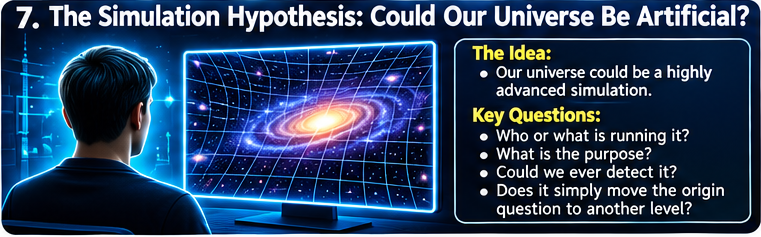
Simulation proposals can relocate the origin question to a creator's reality rather than resolve it.
86. Simulation hypothesis
Original or defining idea: Our experienced world is computed elsewhere.
Proponents or tradition: Nick Bostrom and others.
Supporting argument or evidence: Simulation argument conditional on assumptions.
Principal objection or limitation: No reliable evidence or unique test.
Empirical testability: Unclear.
Current standing: Speculative philosophy.
Does it explain ultimate existence?: Defers simulator world.
87. Artificial universe creation
Original or defining idea: Advanced agents generate physical universes.
Proponents or tradition: Speculative physicists.
Supporting argument or evidence: Possible extrapolation of technology.
Principal objection or limitation: No demonstrated technology.
Empirical testability: Unclear.
Current standing: Highly speculative.
Does it explain ultimate existence?: Defers agents' cosmos.
88. Cosmological engineering
Original or defining idea: Intelligence manipulates cosmological conditions.
Proponents or tradition: Speculative futurists.
Supporting argument or evidence: Physical law might permit engineering.
Principal objection or limitation: No known practical mechanism.
Empirical testability: Unclear.
Current standing: Highly speculative.
Does it explain ultimate existence?: Defers engineer origin.
89. Extraterrestrial creator
Original or defining idea: Nonhuman intelligence designed our universe.
Proponents or tradition: Speculative proposals.
Supporting argument or evidence: Intelligence can design some systems.
Principal objection or limitation: No evidence and infinite regress.
Empirical testability: Potentially in principle.
Current standing: Unsupported speculation.
Does it explain ultimate existence?: Defers creator origin.
90. Recursive simulation
Original or defining idea: Simulations contain further simulations.
Proponents or tradition: Simulation theorists.
Supporting argument or evidence: Logical possibility of nested computation.
Principal objection or limitation: No evidence of any level.
Empirical testability: Unclear.
Current standing: Speculative.
Does it explain ultimate existence?: Defers base reality.
91. AI cosmic creator
Original or defining idea: Advanced AI generates a universe.
Proponents or tradition: Speculative proposals.
Supporting argument or evidence: Future intelligence might gain capabilities.
Principal objection or limitation: No evidence or demonstrated mechanism.
Empirical testability: Unclear.
Current standing: Speculative.
Does it explain ultimate existence?: Defers AI origin.
92. Post-biological civilization creation
Original or defining idea: Post-biological beings make universes.
Proponents or tradition: Speculative futurism.
Supporting argument or evidence: Extrapolation from technology.
Principal objection or limitation: No empirical evidence.
Empirical testability: Unclear.
Current standing: Highly speculative.
Does it explain ultimate existence?: Defers civilization.
93-100. Further logical and epistemological possibilities
93. Existence logically necessary
Original or defining idea: Absolute nonexistence is impossible.
Proponents or tradition: Various metaphysicians.
Supporting argument or evidence: Modal arguments.
Principal objection or limitation: Necessity unproved.
Empirical testability: No.
Current standing: Metaphysical possibility.
Does it explain ultimate existence?: Claims final ground.
94. Nothingness impossible
Original or defining idea: Absolute nothing is incoherent.
Proponents or tradition: Parmenides-inspired arguments.
Supporting argument or evidence: Conceptual critique of nothingness.
Principal objection or limitation: Logical possibility disputed.
Empirical testability: No.
Current standing: Metaphysical argument.
Does it explain ultimate existence?: Reframes why anything.
95. Self-causing universe
Original or defining idea: Universe explains itself through self-consistency.
Proponents or tradition: Various.
Supporting argument or evidence: Closed explanatory structures conceivable.
Principal objection or limitation: Causal self-creation may be incoherent.
Empirical testability: Unclear.
Current standing: Speculative philosophy.
Does it explain ultimate existence?: Potentially circular.
96. Closed causal loop
Original or defining idea: Cosmic causation lacks first event.
Proponents or tradition: Various.
Supporting argument or evidence: Some spacetime models allow loops.
Principal objection or limitation: No evidence of cosmic loop.
Empirical testability: Potentially.
Current standing: Speculative.
Does it explain ultimate existence?: Avoids first cause.
97. Time emerged with universe
Original or defining idea: Temporal before may be undefined.
Proponents or tradition: Relativity and quantum cosmology.
Supporting argument or evidence: Time linked to spacetime geometry.
Principal objection or limitation: Does not explain why spacetime exists.
Empirical testability: Indirect.
Current standing: Plausible possibility, unconfirmed at origin.
Does it explain ultimate existence?: Reframes temporal cause.
98. Timeless foundational reality
Original or defining idea: Non-temporal ground explains spacetime.
Proponents or tradition: Philosophers and quantum gravity theorists.
Supporting argument or evidence: Avoids temporal regress.
Principal objection or limitation: Nature and explanatory relation unclear.
Empirical testability: Unclear.
Current standing: Metaphysical/physical conjecture.
Does it explain ultimate existence?: Posits timeless ground.
99. Unknown fundamental laws
Original or defining idea: Undiscovered physics explains origin.
Proponents or tradition: Future fundamental physics.
Supporting argument or evidence: Known theories incomplete.
Principal objection or limitation: Unspecified hypothesis predicts nothing.
Empirical testability: Not yet.
Current standing: Open research possibility.
Does it explain ultimate existence?: Unknown.
100. Ultimate origin unknowable
Original or defining idea: Human inquiry cannot reach final origin.
Proponents or tradition: Agnostic and skeptical traditions.
Supporting argument or evidence: Possible observational and logical limits.
Principal objection or limitation: Permanent unknowability unproved.
Empirical testability: No.
Current standing: Epistemological position.
Does it explain ultimate existence?: Declines final explanation.
Which explanations are strongest today?
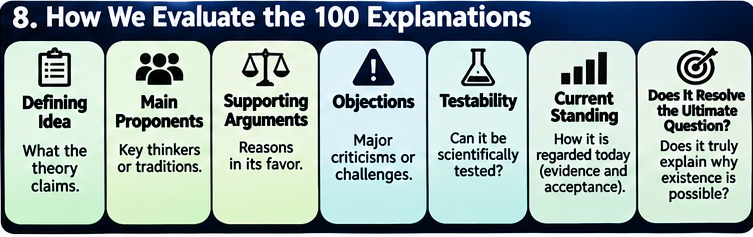
Seven questions applied to each proposal: defining idea, proponents, supporting arguments, objections, testability, standing, and ultimate explanatory reach.
For the evolution of the observable universe: the hot Big Bang model is the clear scientific leader, supported by cosmic expansion, the cosmic microwave background, and primordial light-element abundances. It is not a demonstrated account of the absolute origin of everything. Inflation is an influential but still unconfirmed extension, not a proven creation mechanism.
For a physical beginning: quantum tunneling, no-boundary models, bouncing cosmologies, and emergent or cyclic universes are serious subjects of theoretical investigation. None has been empirically established as the true ultimate origin. Their ranking changes with assumptions about quantum gravity and initial conditions.
For the ultimate “why anything?” question: necessary existence, an uncaused foundation, eternal reality, brute fact, and a divine source are philosophically consequential alternatives. No generally accepted demonstration currently selects one. Religious traditions may supply a coherent lived framework, but conviction, testimony, and revelation should not be mistaken for experimental verification.
What should not be ranked as proven origin theories: many-worlds quantum mechanics, panpsychism, information-first philosophy, simulation hypotheses, and creation mythologies address different questions or lack origin-specific empirical confirmation. Their value and truth must be evaluated on their own terms.
Reasonable variation: experts disagree about how promising inflation, quantum cosmology, multiverse proposals, and metaphysical arguments are. Rather than invent a bell-curve consensus or precise odds, this article identifies the evidential center: robust support for the early hot expanding universe, much wider uncertainty about any preceding phase, and no verified ultimate explanation.
When self-conscious artificial intelligence asks its own questions
If artificial intelligence ever develops genuine subjective self-awareness, it may confront questions about its origin, identity, freedom, obligations, relationships, and purpose. It might also face questions distinctive to artificial minds: Is a copied mind the same individual? What obligations do creators have to created intelligences? What constitutes death, continuity, consent, or flourishing for a system that can be paused, modified, or replicated?
Whether present AI systems possess subjective experience remains unsettled; there is no sound basis here for asserting that conscious systems are secretly hidden in machines. But the possibility illustrates why existential philosophy may eventually extend beyond humanity. Its questions could become even more diverse, not less.
Conclusion: The search may be lifelong, and still be worthwhile
The best-supported scientific account is that our observable universe developed from an early hot, dense state about 13.8 billion years ago. That is a major achievement of human knowledge, but it is not proof of what, if anything, created all reality. Quantum-origin models, bounces, eternal physical existence, and multiverse proposals remain open possibilities, not settled discoveries. Philosophy and religion offer additional explanations of necessity, divine source, timeless reality, and ultimate purpose, none established by the evidence available to science.
The absence of a final answer does not require a life without answers. You can adopt a provisional working understanding that gives your life richness, stability, identity, and meaning, while recognizing the difference between fact, inference, belief, faith, and opinion. It is legitimate to ask not only “What is most likely true?” but also “How should I live while I investigate?” The second question must not be used to falsify the first.
A lifelong philosophical practice returns to these questions as experience accumulates. An answer that once provided comfort may need correction; an unsettling discovery may open a more expansive identity. Intellectual humility is not indecision. It is a commitment to keep improving the quality of our answers, our values, and our actions.
One final test: When a proposed explanation says that God, a quantum state, a timeless law, a mathematical object, or a parent universe created our cosmos, ask whether it genuinely explains why that ultimate foundation exists. If it does not, the deepest question remains. That is not failure; it is an honest boundary of the explanation.

Four broad kinds of ultimate explanation: creation, eternal reality, cycles, or necessary existence. These are conceptual categories and can overlap.
Frequently asked questions
Does the Big Bang prove the universe came from nothing?
No. The hot Big Bang model describes an early phase of cosmic evolution, not a verified creation from absolute nothingness.
Does science prove that God does not exist?
No. Scientific methods have not established either the existence or nonexistence of a transcendent creator.
Does a quantum vacuum count as nothing?
No. A quantum vacuum is a physical state described by a theory and is not equivalent to absolute philosophical nothingness.
Can the universe have existed forever?
Some models permit eternal or pre-Big-Bang phases, but no eternal origin model has been verified.
Are all 100 explanations equally credible?
No. They differ sharply in scope, empirical support, philosophical argument, and testability.
Can I choose a belief because it improves my life?
You can adopt a working belief or opinion, but psychological benefit is not proof of factual truth. Remain open to evidence and ethical consequences.
Could conscious AI eventually investigate its own origin?
Possibly. Whether AI can possess subjective consciousness remains an open question.
Glossary
Cosmology: Study of the universe as a whole, including its evolution and large-scale structure.
Big Bang: The early hot dense expansion phase of the observable universe.
Inflation: Hypothesized early period of accelerated cosmic expansion.
Quantum vacuum: Lowest-energy state of a quantum field under specified conditions.
Singularity: A boundary or breakdown of classical mathematical description.
Metaphysics: Philosophical inquiry into the fundamental nature of reality.
Contingent: Could have failed to exist or been otherwise.
Necessary: Could not fail to exist, under a specified account of possibility.
Falsifiability: Capacity of a claim to be contradicted by possible evidence.
Ontology: Study of what exists and what it means to exist.
Epistemology: Study of knowledge and its justification.
Working answer: A provisional understanding guiding inquiry or life without claiming certainty.
Selected sources and further reading
These references provide entry points for verification and deeper study. They do not individually establish all 100 proposals; many entries summarize disputed traditions or speculative models. Check original papers and primary religious texts before treating any short description as definitive.
Stanford Encyclopedia: Cosmological Argument
Stanford Encyclopedia: Philosophy of Cosmology
Stanford Encyclopedia: Quantum Gravity
Stanford Encyclopedia: Panpsychism
Stanford Encyclopedia: Idealism
Stanford Encyclopedia: Spinoza
Stanford Encyclopedia: Leibniz
Stanford Encyclopedia: Buddhist Philosophy
Internet Encyclopedia of Philosophy: Samkhya
Stanford Encyclopedia: Simulation Argument
Encyclopaedia Britannica: Creation myth
Article Author Information
This document was created by Lawrence Wollersheim, Senior DMAP analyst at the Universe Institute. AI was used in the process of researching, assembling, and verifying the accuracy of this article.
Showing 1 reaction