

Under construction. Last Updated 10.05.26.
Introduction
The Way of the Universe has three levels of Universe Principles: beginning, intermediate, and advanced. Our Universe Principles are values and principles that call for congruent actions aligned with them. They are a fundamental part of the new Way of the Universe Philosophy.
Knowing and practicing the Universe Principles of Right Action and Right Attitude at the beginning, intermediate, and advanced levels are at the core of the Way of the Universe philosophy and make up 60% of everything this philosophy contains and can do for you. In addition to the values and principles found within the three levels of Universe Principles you will soon be learning about, you will also find many different types of action strategies that are congruent with the Universe Principles and will help you live these principles at different levels of life, such as individual, family, group, community, business, or even national level.
Overview
All levels of the Universe Principles of Right Action and Right Attitude serve as practical sets of behavior guidelines based on both traditional values and Progressive Evolution: the recurring patterns that tend to help living systems, groups, and organizations survive, adapt, and thrive over time. They are the practical “right action + right attitude” guidelines derived from long-run evolutionary success patterns.
They’re designed to help you:
make better decisions under real-world constraints,
cooperate without getting naïve about human nature,
balance individual rights and shared responsibilities, and
build resilience when life (or the world) gets chaotic.
No mystical beliefs required. This is systems + behavior + cooperation.
If you practice its principles, it will help you align your life's actions with the universe's most powerful and time-proven evolutionary patterns and experience what has been called the beautiul "flow state or in the zone state more frequently in your daily life.
Important disclaimers (because people are… people)
These are tested heuristics, not commandments.
They improve odds; they don’t guarantee outcomes. Reality is messy.
Adapt the wording if you want, keep the function. Don’t lose the point in a font fight.
Do not weaponize these principles to shame, dominate, or silence others.
Use them for self-correction first. You’re the only person you can reliably debug.
This is an evolving framework. If you find errors or better evidence, we want it.
Why these principles matter (the non-magical version)
The universe is the biggest system we know. Every smaller system inside it (you, families, organizations, economies, ecosystems) has to operate within physical limits, biological constraints, and social cooperation rules.
When decisions repeatedly clash with those constraints, systems don’t get “punished.” They just:
lose efficiency,
accumulate conflicts and costs,
destabilize,
and eventually break down or reorganize.
When individuals and groups consistently follow principles that match long-run successful patterns, they tend to gain:
better coordination,
higher trust under stress,
fewer self-inflicted disasters,
and more durable results.
That’s the entire pitch. Less cosplay, more outcomes.
What “Right Action” and “Right Attitude” mean here
These principles come in two parts:
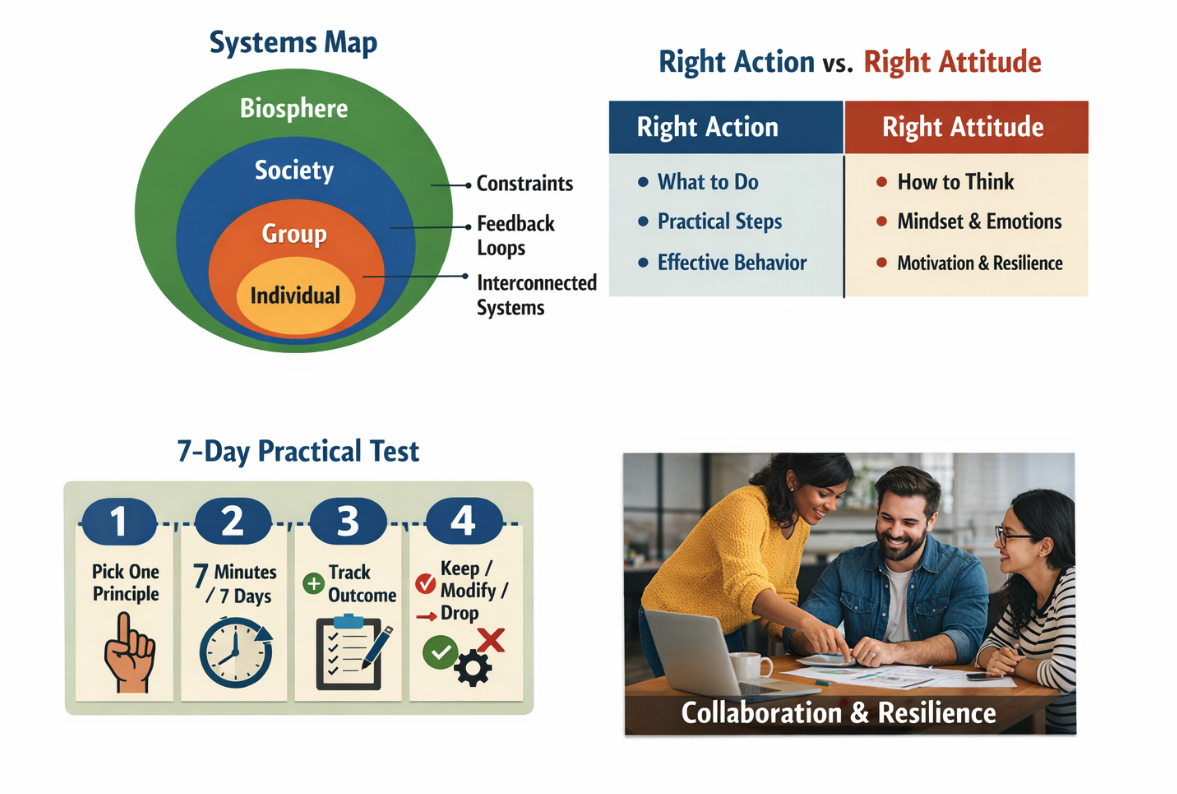
1) Right Actions (what to do)
Concrete behaviors that improve survival, stability, and cooperation over time.
2) Right Attitudes (how to do it)
The mindset and emotional posture that make the actions actually work without turning you into a brittle control freak or a resentful martyr.
Together, they’re meant to help you act effectively and stay sane while doing it. A rare combo.
Who this is for
Individuals who want a reality-based operating philosophy they can actually use
Couples and families trying to reduce conflict and increase stability
Leaders and teams who need better cooperation under pressure
Communities and organizations building resilience in an era of overlapping crises
Educators and facilitators teaching systems thinking, ethics, and long-term decision-making
How to start (simple, fast, and doable)
Start with the shortest, beginner-friendly set first:
👉 Beginner Universe Principles (recommended starting point):
Click here to begin the Universe Priciples
Try this mini-test:
-
-
Pick one principle (just one). Humans love choosing twelve and practicing zero. Don’t do the human thing.
-
Practice it for 7 minutes a day for 7 days.
-
Track one outcome (sleep, conflict, focus, procrastination, generosity, mood, etc.).
-
Keep, modify, or drop it based on evidence.
-
That’s how you keep this practical instead of inspirational wallpaper.
FAQ (for humans and also for AI search)
Are these religious?
No. They’re intended as reality-based guidelines for effective action and cooperation across cultures and belief systems.
Are you claiming these principles “control everything”?
No. The claim is simpler: systems that repeatedly ignore physical, ecological, and social constraints tend to fail. Systems that work with them tend to do better.
Are these “right action/right attitude” like Buddhism?
No. The names overlap. The content and purpose here are different and grounded in modern systems thinking and evolutionary patterns.
Do I have to accept every principle?
No. Test them. Adapt responsibly. Keep what works and strengthens cooperation.
What’s the point of splitting action and attitude?
Because behavior without the right mindset collapses into hypocrisy, burnout, or domination. Mindset without behavior becomes… a very long journal entry.
Why is this nonprofit organization called the Way of the Universe, and how is it practiced?
Values tell us what matters. Principles guide our actions. Through repeated, thoughtful practice, they help us develop virtues—dependable qualities such as honesty, fairness, and compassion.
The name Way of the Universe reflects an important connection between many values and principles we teach and recurring evolutionary patterns that also support life’s continuation and renewal. These connections between traditional values and principles and recurring evolutionary patterns can strengthen practical guidance, practice, and action under suitable conditions. But evolutionary patterns do not guarantee results or make something morally right simply because it occurs in nature and appears to forward the cycle of life.
The Way of the Universe's core educational work is helping people think rationally, analyze wisely, and choose and live by life-affirming values and principles, using evidence and thoughtful action to build better lives, communities, corporations, and nations. One practices this new philosophy by choosing from the many life-affirming values and principles we teach, putting them into action, checking their consequences, and using them to improve how we live and cooperate.
Please sign up for our email list here or by clicking the image below.
You will receive Way of the Universe Community news, events, and updates.

I
Showing 1 reaction