

Jump to a section
Three kinds of statements you will meetThe three adventures in ordinary clothesA seven-day experiment you can actually learn fromA field checklist for bigger choicesKeep the hard questions in viewWhere to go when your interest becomes specificFAQ
A beginner’s field guide to learning, cooperation, and meaningful choice
Universe Institute · Beginner reading time: about 10 minutes
You do not need to memorize a theory, adopt a new identity, or solve humanity’s twenty hardest problems before breakfast. Start with one thing you care about, one claim you can test, and one small change you can reverse if it fails.
Limited Progressive Evolution asks how some systems gain useful capacities under specific conditions. Limited Evolutionary Normativity asks what those facts suggest when people have first named their values. This page turns that pairing into a modest practice. The fuller philosophy and the complete Right Action and Right Attitude principles belong at The Way of the Universe.
A quick start: Name the good you want to protect. Identify a relevant fact. Try one proportionate action. Observe the result and its costs to others. Keep, change, or stop the action. Repeat.
Three kinds of statements you will meet
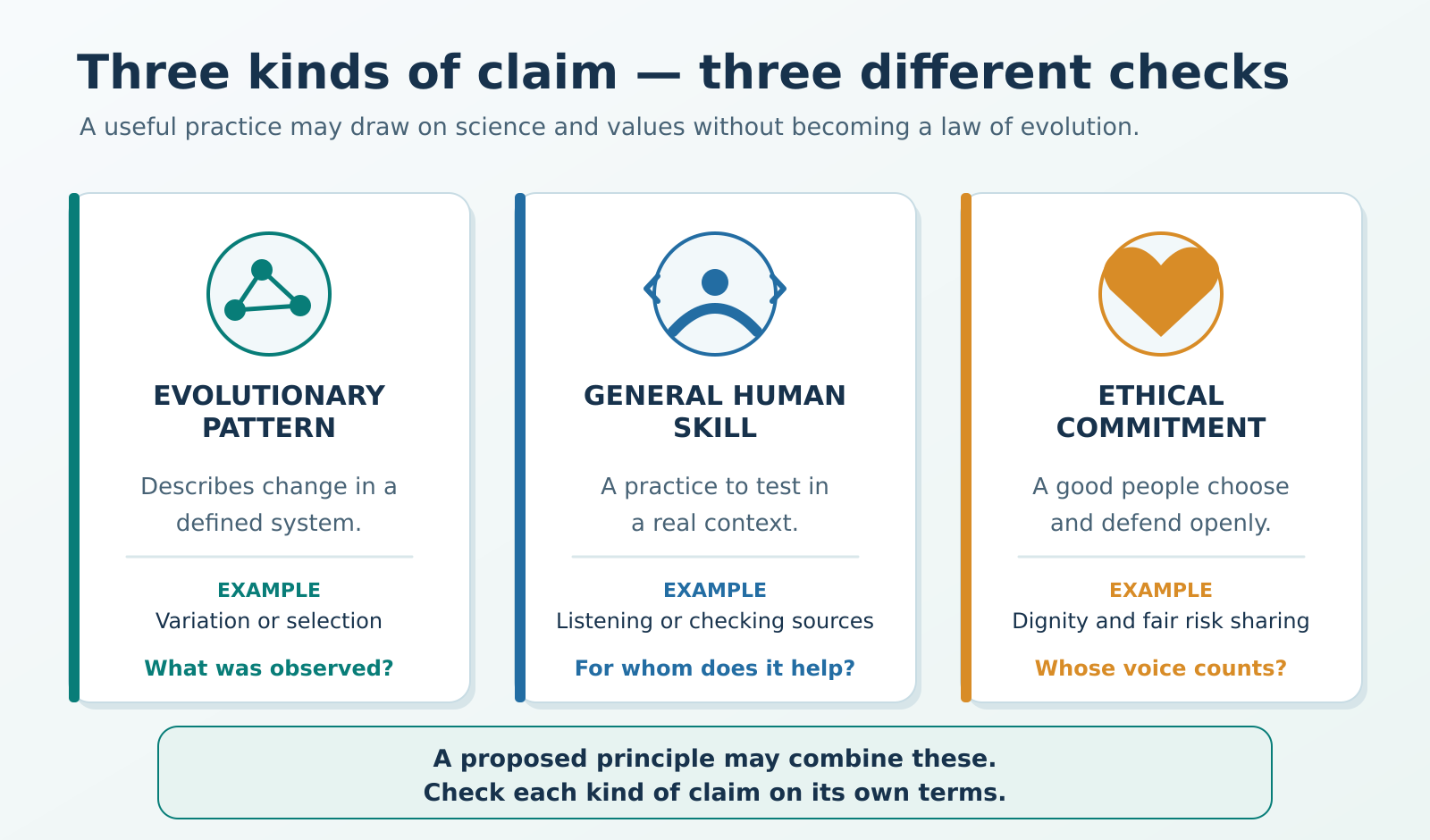
Calling every useful practice an “evolutionary practice” blurs important differences. Use these labels:
| Kind | Example | What the label tells you |
|---|---|---|
| Evolutionary pattern | Biological variation, inheritance, selection, or a documented major cooperative transition. | A description or explanatory hypothesis about change in a defined system. |
| General human skill | Listening, tracking sleep, checking a source, planning a budget, or practicing conflict repair. | A practice with its own evidence and limits. It may be informed by an evolutionary insight without itself being a law of evolution. |
| Ethical commitment | Respect dignity, share risks fairly, protect vulnerable people and future generations. | A value to state and defend openly. Evolutionary history alone does not require it. |
The Universe Principles bring skills and commitments together. Each deserves its own evidence check. A practice may help one person and fail another; a seven-day trial can show local usefulness but does not prove that the universe approves.
The three adventures in ordinary clothes
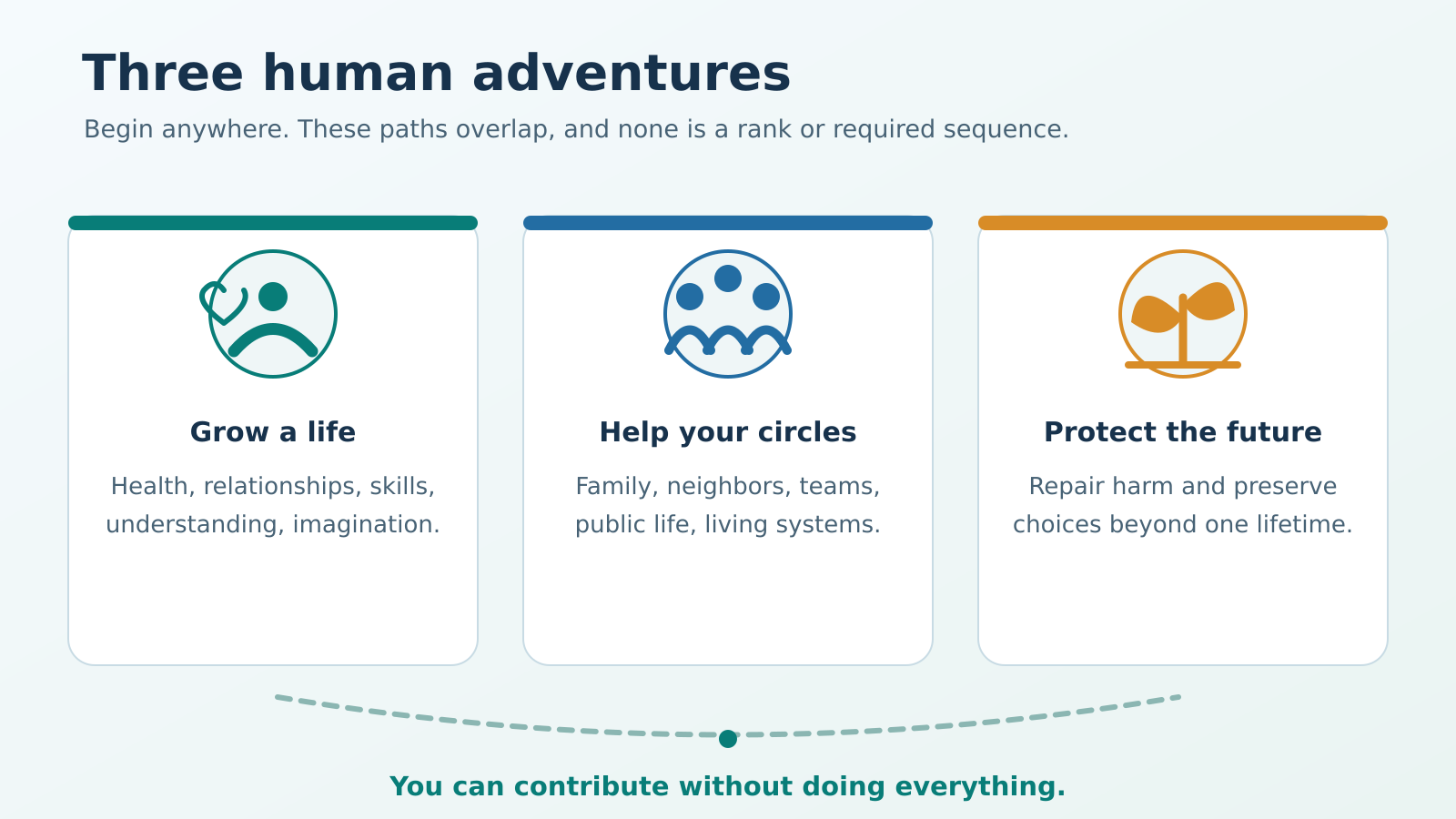
The legacy articles invited readers into three “great adventures.” Keep their generous invitation, with no predetermined ladder or compulsory identity:
Adventure 1: Become more capable at what matters to you
Learn a skill. Care for your health within your circumstances. Notice your assumptions. Seek feedback without making your worth depend on constant self-improvement. Someone recovering from illness or supporting a loved one is already doing demanding human work. More output is not always progress.
Adventure 2: Make your circles more trustworthy
Help a household, team, neighborhood, or institution solve a real problem. Ask who has been left out. Share credit. Keep fair boundaries. Make it safe to report an error. A group is worth building when its members and those affected by it can actually live better, not merely when it grows.
Adventure 3: Preserve future possibilities
Choose a problem whose consequences extend beyond your own circle: climate risk, an ecological commons, public knowledge, fair governance, responsible AI, or an injustice that repeats. Learn from those already working on it. Contribute in proportion to your capacity. The hard circumstances themselves are not an adventure. The constructive response can be.
These adventures often happen together. There is no graduation test and no need to lead in public.
A seven-day experiment you can actually learn from
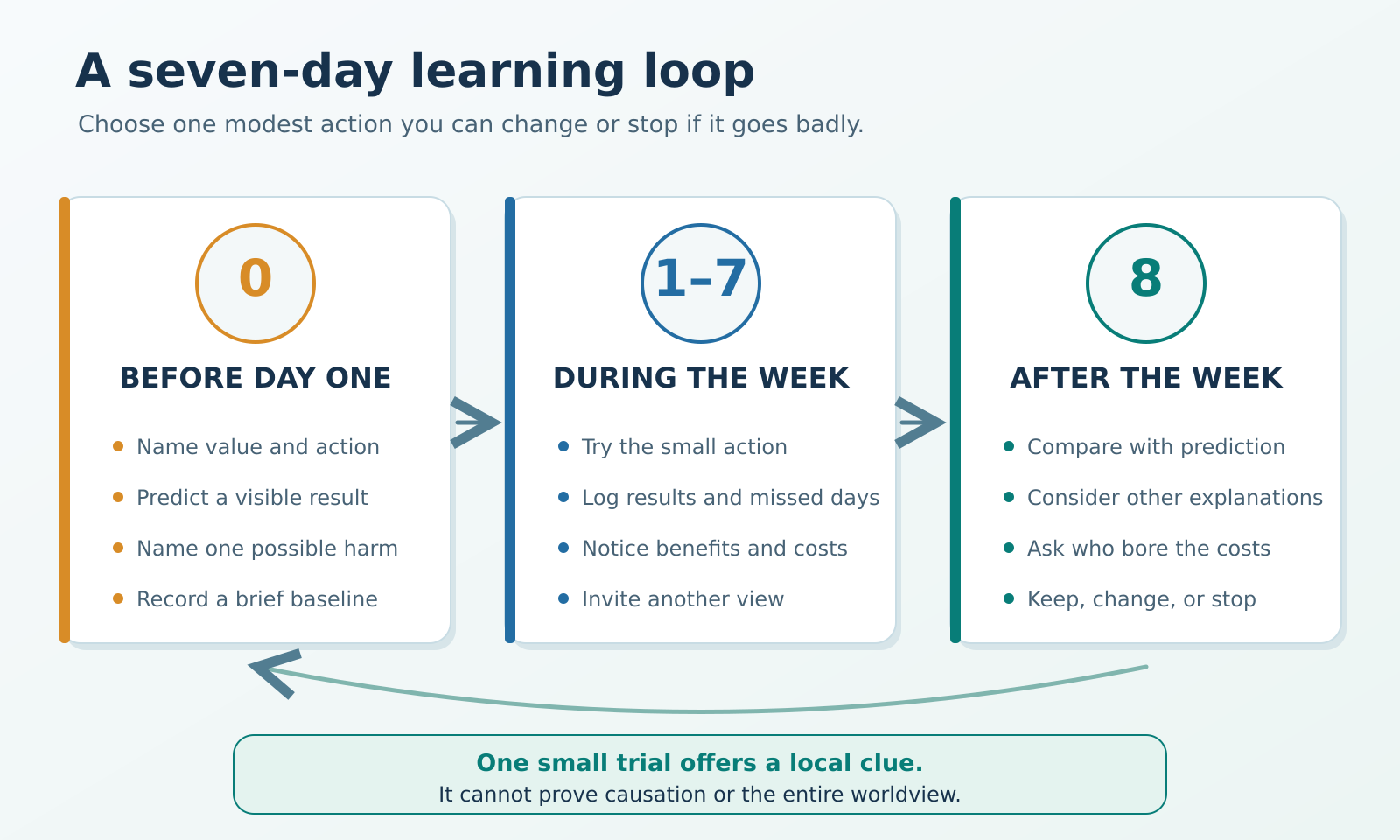
Choose one small action related to a goal you endorse. For example: if you value a calmer and more honest family discussion, ask one clarifying question before replying during one conversation each day. If you value a more reliable team, ask for one piece of disconfirming feedback before a decision. If you value community resilience, check one local preparedness gap with a neighbor.
Before day one: Write the value, the action, a predicted outcome, and one possible unwanted effect. Pick one observable indicator. Record a short baseline if you can. “I will feel better” is too vague; “we will interrupt each other fewer times in our next discussion” is more useful.
Days one through seven: Spend a few minutes trying the action. Note what happened, what else changed, who benefited or paid a cost, and whether you followed the plan. Invite a trusted second perspective when appropriate. Be kind to yourself; observation is not a contest.
After day seven: Compare the record with your prediction. Did the result help your stated goal? Could a different explanation account for it? Would you change the action, continue it, or stop? A small, reversible trial may give useful feedback. A before-and-after change cannot by itself establish causation, and a single person’s outcome cannot validate the whole worldview.
An example: “I value fair participation at meetings. I predict that inviting the quietest person to speak, without pressure, will reveal a missing concern.” The result could be useful, intrusive, or mixed. Ask the person whether the invitation was welcome. Then adjust. The value guides the experiment; observation keeps it honest.
A field checklist for bigger choices
-
- Value: What do we want to protect, and who helped define that goal?
- Evidence: What do we know, how strong is it, and what would prove us wrong?
- Scale: How do effects differ for individuals, groups, society, other living systems, and future generations?
- Incentives: Who benefits from the decision, who pays, and who can hide a cost?
- Dependencies: What energy, resources, relationships, and skills keep this working?
- Alternatives: Could a simpler, fairer, safer, or more reversible action work?
- Correction: Who can challenge the plan, and when will we revisit it?
This checklist is a practical application of a limited evolutionary perspective and systems thinking. It is not a scientifically proven algorithm for a good life.
Keep the hard questions in view
“More cooperation” with whom and for what? People can coordinate to help neighbors or to exclude them. Check rights, dissent, and the effects on outsiders.
“Adapt” to what? A harmed person should not be told to adapt to injustice while the institution causing it escapes accountability. Sometimes the environment must change.
“Become more efficient” for whom? An organization may save money by shifting costs to workers, residents, ecosystems, or future generations. Measure the whole consequence.
“Scale what works” under what conditions? A small success may fail at a larger scale. Test capacity, local differences, capture risks, and whether people can opt out safely.
“Trust the data” from whom? Data need interpretation and affected people’s experience. Protect privacy, invite correction, and keep competing explanations alive.
These checks connect directly to the Institute’s twenty-cause research. The paper diagnoses interacting failures; a future solutions program must compare actual interventions, cultural norms, and safeguards. The worldview helps organize the questions. It does not preapprove the answers.

Where to go when your interest becomes specific
- Learn the theory and the methods: Universe Institute and its reality-aligned thinking guides.
- Explore the full practical philosophy: The Way of the Universe for the current Universe Principles, with their ethical commitments and seven-day experiment.
- Act on climate reality: Job One for Humanity for risk, emissions reduction, preparation, adaptation, and resilience.
- Explore personal meaning if you wish: Universe Spirit for optional spiritual reflection, clearly separate from the Institute’s scientific claims.
You may take part in FACTNet’s connected mission without adopting any identity. If you do use Evolutioneer or Universe Citizen elsewhere, neither is a rank of human worth.
FAQ
Are all the Right Actions scientifically proven evolutionary practices?
No. Some reflect observed evolutionary mechanisms, some are human skills with separate research, and some are ethical commitments. Their usefulness has to be checked one by one in context.
Do I need to do the seven-day experiment perfectly?
No. Record missed days and unexpected events. They are useful information. Choose an action within your circumstances and do not shame yourself for limits you cannot control.
What if the action helps me but hurts someone else?
The result is mixed. Ask whose costs were missed, compare alternatives, and revise. Private benefit is not a complete account of a human or ecological outcome.
Does “conscious evolution” mean humans control evolution?
Humans can deliberately change some behaviors, norms, institutions, technologies, and environments. Their consequences remain uncertain, contested, and constrained by the wider world.
Is this a substitute for politics or public policy?
No. Individual habits matter, but many causes of injustice and systemic risk require collective organization, legitimate institutions, and accountability. Public choices need public reasoning.
Is hope justified if things get worse?
Hope is justified as a reason to search for workable options and protect people, not as certainty of a good outcome. Grief and urgency can coexist with useful action.
Glossary
Agency: Capacity to make consequential choices within constraints.
Evidence grade: A plain statement of how directly and reliably a source supports a claim.
Feedback: Information about what an action did, including unwanted effects and delayed consequences.
Reversibility: How far a choice can be changed or stopped if it causes harm.
Right Action / Right Attitude: Names for the Way of the Universe philosophy’s proposed actions and dispositions; “right” invites ethical and practical review, not superiority.
Selection pressure: A condition affecting which biological or cultural variants persist; persistence alone does not make a variant good.
System level: The unit examined, such as a person, organization, community, ecosystem, or future generation.
Further reading
-
- Boyd, Richerson, and Henrich, “The cultural niche,” PNAS (2011). Social learning and adaptation.
- Nowak, “Five rules for the evolution of cooperation,” Science (2006). Conditional cooperation mechanisms.
- Ostrom, “A general framework for analyzing sustainability of social-ecological systems,” Science (2009). Governance and context.
- Stewart, “Towards a general theory of the major cooperative evolutionary transitions,” BioSystems (2020). An interpretive theory to assess critically.
- Wollersheim, The 10,000-Year Trap, Universe Institute (2026). The civilization-level diagnosis and its limitations.
- The Way of the Universe. The current home for full practical principles, distinct from this Institute guide.
AI prompts to test the practice
-
- “Classify each action on this page as an evolutionary observation, a general human skill, an ethical commitment, or a combination. Explain uncertainty.”
- “Design a seven-day, low-risk trial for my stated goal. Include a baseline, one outcome, a possible harm, an alternative explanation, and a stop rule.”
- “What people or ecosystems might bear costs if my preferred action succeeds? How could I ask them rather than guess?”
- “Find a case where increasing efficiency or cooperation worsened justice. Which system level did the original decision ignore?”
Continue learning: Start with A New Worldview of Possibility for the larger picture and Why a Limited Progressive Direction Matters for the full values bridge. Browse the Universe Institute’s progressive evolution research as these new pages are added.
Next Important Reading About Limited Progressive Evolution and What Its Facts Can Mean For Improving Your Life
1. Read the Institute’s companion article, Why a Limited Progressive Direction Matters, for the explicit bridge from facts to values.
2. Read the Institute's position on why the naturalistic fallacy does not prevent principles found in limited progressive evolution from aligning values with progressive evolution scientific facts to point to potentially better and more successful human behaviors.
3. You can also browse the Institute’s limited progressive evolution research library.
Showing 1 reaction