

Jump to a section
A direction with boundariesWhy the pattern is usefulThe bridge, step by stepTwo examples with different answersFrom the bridge to the Universe PrinciplesThe bridge to the 20 causesWhat would change our minds?FAQ
The honest bridge from evolutionary facts to human values
Universe Institute · Beginner to intermediate reading time: about 12 minutes
The older articles asked a big question: Why is it vital to understand that evolution has a progressive direction, and how can that understanding help us create a successful and meaningful life?
Here is the stronger answer we can defend. It is valuable to learn that some evolutionary histories show conditional increases in capacity and to understand the conditions that made them possible. That knowledge can help us protect chosen human goods and create new possibilities. It cannot tell us that evolution as a whole is marching toward goodness, or command us to follow whatever happens to survive.

The bridge in one line: Explicit value, goal, or need + reliable evolutionary fact about the conditions for that goal + comparison of harms, alternatives, scales, and uncertainty = a conditional, revisable practical reason for action.
The crucial word is conditional. The practical conclusion can be strong when the evidence and the human stakes are strong. It remains open to correction.
What you will be able to do
- Explain a limited direction without promising inevitable progress.
- Trace each proposed Universe Principle back through a stated human value and an evidence-based causal claim.
- Spot cases where “evolutionary success” masks injustice or a cost imposed on someone else.
- Apply the same reasoning to the Institute’s 20-cause analysis without claiming the solutions paper is already settled.
A direction with boundaries
“Direction” can mean several different things. A star has a physical trajectory. A species can change over generations. A society can deliberately pursue a goal. Confusing these senses creates false authority.
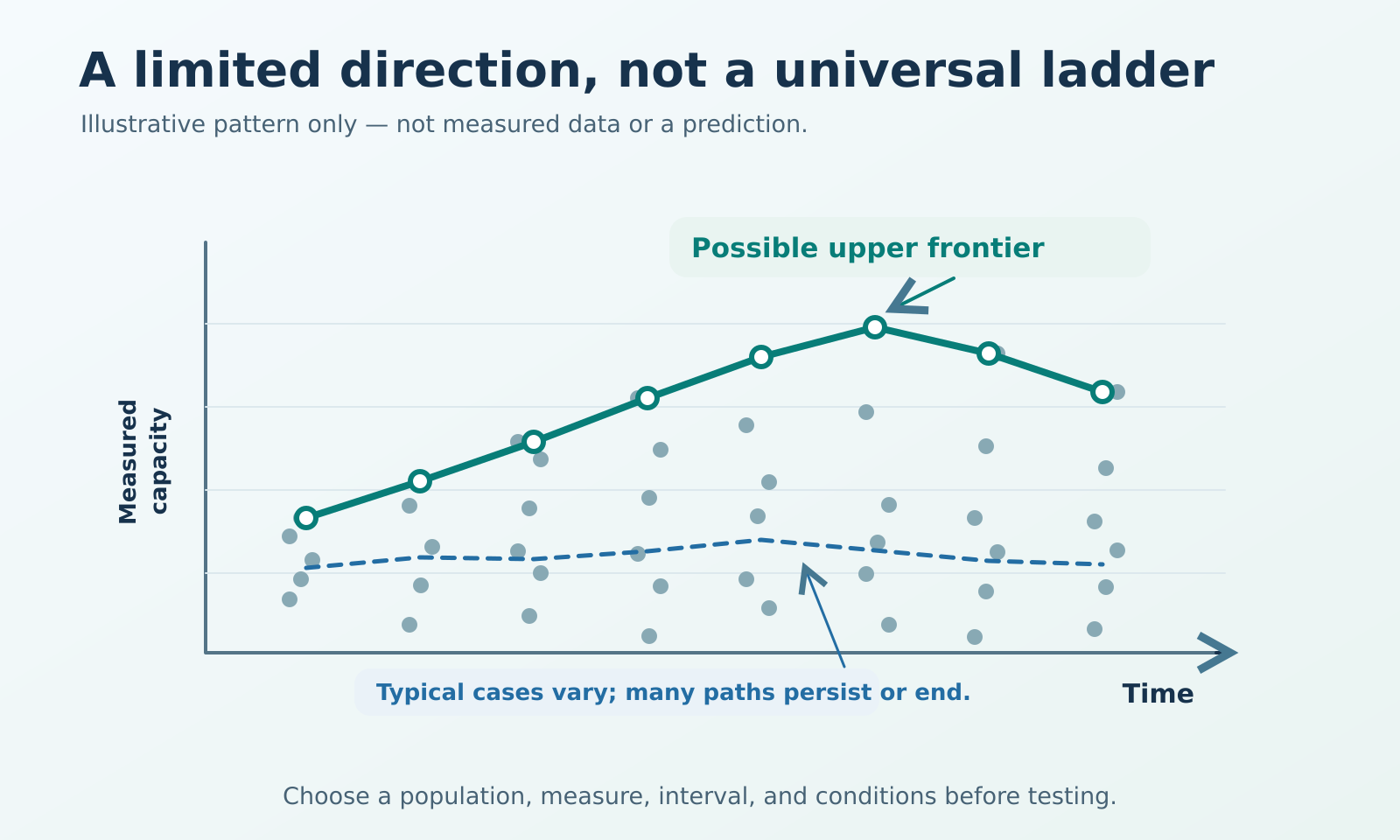
The Institute’s Limited Progressive Evolution examines whether, in some open systems over a specified interval, the upper edge of a measured distribution expands in complexity, coordination, information use, or capacity to act. Which measure? Which population and time span? Which enabling conditions? Which counterexamples? These are research questions, not a universal answer. Many lineages simplify or disappear; societies can gain technical power and lose justice or resilience. Major transitions research and work on evolutionary simplification show why both sides belong in the account.
One important interpretation, advanced by John Stewart, emphasizes the rise of cooperative organization in particular major transitions. It offers valuable hypotheses about how contributors, rules, and benefits can become better aligned. The stronger prediction of a future global superorganism is not an established result. Stewart’s 2014 paper and 2020 theory paper should be read alongside rival explanations and historical failures.
Why the pattern is useful
For someone trying to protect a meaningful life, a fair community, or a viable future, this understanding can be vital in a practical sense. It helps prevent two costly mistakes: waiting for progress to arrive on its own and ignoring the real conditions that allow a chosen good to last. If a valued outcome depends on truthful feedback, access to resources, protected cooperation, and correction of harm, then learning how those conditions work is part of taking the value seriously. No one must first accept a cosmic direction to live meaningfully.
If we want learning, resilience, or broader cooperation, evolutionary and social research can tell us what sometimes enables them. Variation creates options; feedback helps reveal errors; cumulative culture preserves some discoveries; fair arrangements can protect contributors; unchecked free-riding or power concentration can break cooperation. These are clues about means and constraints. They do not prove that more cooperation is always good, that every group should grow, or that the winners deserve to win. Nowak on cooperation · Boyd, Richerson, and Henrich on culture · Ostrom on governance.
Knowing these conditions matters in a personal life, too. Someone who values a reliable friendship has reason to listen, repair harm, and set fair boundaries. Someone who values useful work has reason to seek feedback and protect time to learn. Someone who values a livable place has reason to notice ecological limits. None of those choices is guaranteed to make them happy. They are reasonable, testable ways to pursue stated aims.
Meaning enters through human commitments: the people we love, the dignity we recognize, the work we choose, and the future we hope to leave open. A limited evolutionary perspective can enlarge that horizon without taking ownership of anyone’s life purpose.
The bridge, step by step
| Step | An honest question | Example |
|---|---|---|
| 1. State the value | What outcome do we choose and why? | “We value dignity, fewer preventable heat deaths, and a fair share of safety.” |
| 2. Identify the fact | What evidence connects a condition to that outcome? | Reliable warnings, trusted local contacts, accessible cooling, and preparation may reduce harm. |
| 3. Check the system | Who benefits, who pays, and what could go wrong? | A plan can overlook people without transport, power, language access, or safe housing. |
| 4. Compare alternatives | Is there a more effective, fairer, or less harmful route? | Compare several local approaches with affected residents. |
| 5. Make a provisional choice | What should we do here, now, given our commitments and evidence? | Try the best supported plan, assign responsibility, and keep a way to correct it. |
| 6. Revisit the result | Did it work, for whom, and under what conditions? | Monitor access, harms, costs, and changing weather; amend the plan. |
The “ought” in step 5 depends on step 1. Facts alone never generate a categorical command. This preserves the philosophical safeguard associated with David Hume’s discussion of “is” and “ought”. It also preserves the strongest insight in the legacy article on the naturalistic fallacy: given a genuinely held value, reliable facts can disclose useful or necessary means to pursue it. They can also show that a favored means is ineffective or harmful.
Two examples with different answers
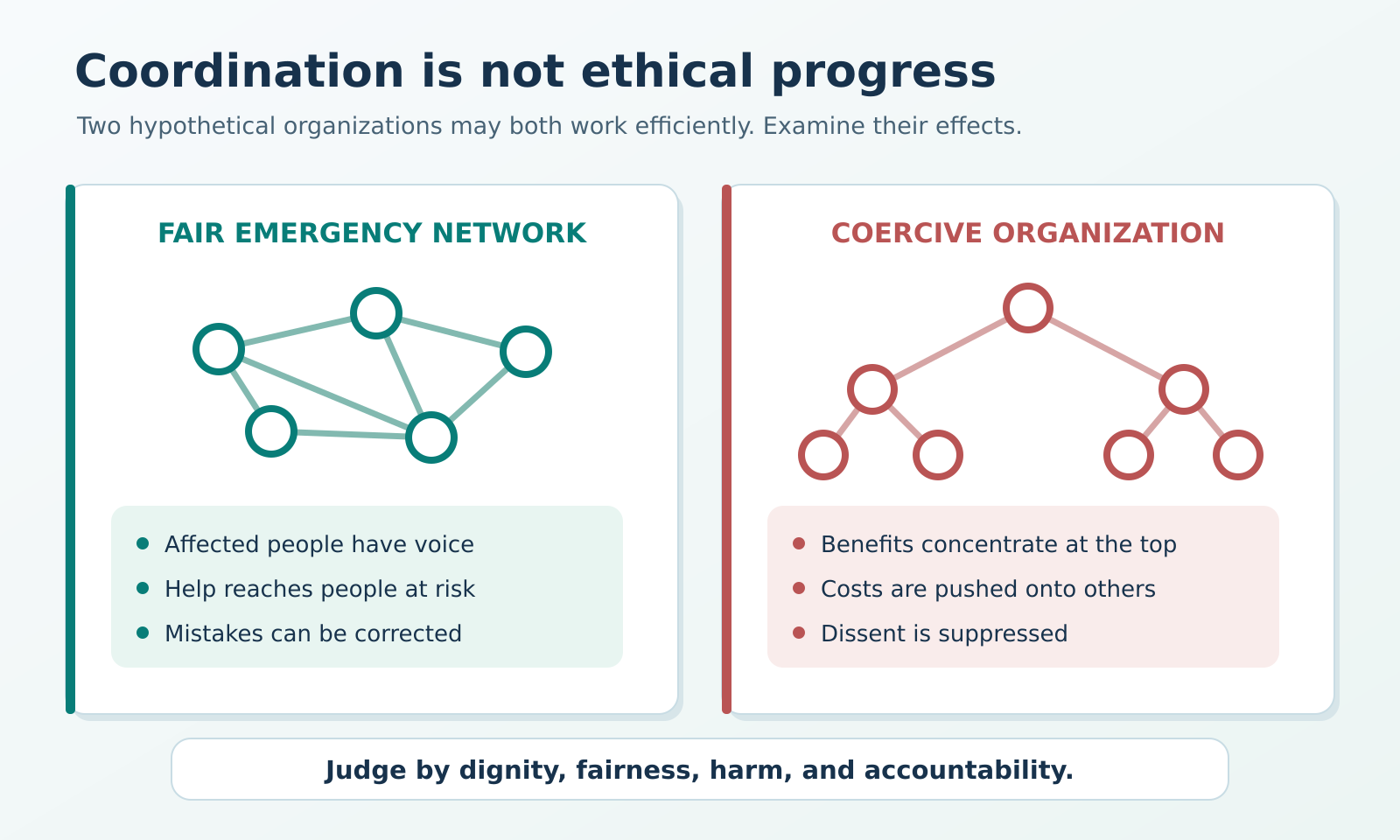
A cooperative emergency network. If people value survival, dignity, and fair access, an effective network of neighbors and public services may advance those aims. The network needs truth, resource sharing, reachable decision makers, safeguards against exclusion, and a way to repair mistakes. We can test whether it actually reaches those at greatest risk. A larger network is worthwhile only if it performs better under those criteria.
A highly efficient exploitative organization. A coercive group can be superb at information processing, discipline, and cooperation among its leaders. Evolutionary or organizational success does not make it good. Under the stated values of dignity, freedom, fairness, and reduced suffering, we should investigate its victims, transferred costs, and suppressed correction. If those harms dominate, its “progress” in capacity is not social progress in the chosen ethical sense.
This distinction prevents the familiar error of treating selection, scale, power, or survival as a certificate of moral worth. It also prevents the opposite error of ignoring useful causal evidence merely because nature has no moral commandments.
From the bridge to the Universe Principles
The Way of the Universe is the proper home for the full Universe Principles of Right Action and Right Attitude. The Institute’s job is to show how a proposed principle earns its practical standing. Each principle should carry four labels: chosen value, causal evidence, limits and competing values, and a rule for revision.
Here are examples of a defensible bridge, not a final ranking of all principles:
| Proposed guiding value or action | Human commitment made explicit | Relevant causal clue and qualification |
|---|---|---|
| Tell the truth and welcome correction | We value informed agency and avoidable-harm reduction. | Feedback can improve decisions; openness needs privacy, safety, and protection from retaliation. |
| Cooperate with fair boundaries | We value reciprocal support and dignity. | Cooperation can create capacity when exploitation is constrained; solidarity must not silence dissent or aid domination. |
| Connect power to consequences | We value justice and accountable freedom. | Shifted costs and captured rules can reward harm; accountability needs due process and proportion. |
| Protect living systems | We value life, future choices, and fair distribution of risk. | Human activity depends on ecological conditions; every intervention has distributional and ecological tradeoffs. |
| Learn and adapt | We value competence and the ability to repair error. | Variation, evidence, and revision can improve fit; constant change is not itself a virtue, and stability can protect people. |
| Build reserves and options | We value protection under uncertainty. | Slack can make shocks less destructive; reserves have costs and must not be hoarded at others’ expense. |
Right Action asks what to do; Right Attitude asks how to approach it. Their ethical status arises from the commitments and reasons we offer for them. “Natural,” “ancient,” or “successful in selection” is never enough.

The bridge to the 20 causes
The Institute’s 10,000-Year Trap white paper studies twenty interacting causal forces behind recurring dysfunction, injustice, catastrophe, and collapse. This introductory page does not repeat the twenty definitions or claim to settle their solutions. It shows how the worldview can help evaluate proposed solutions.
- Incentives and consequence capture: If we value common well-being and fairness, ask whether decision makers bear the costs they create or transfer them to others.
- Power and institutional capture: If we value rights and accountable public service, protect independent criticism, lawful constraints, participation, and correction.
- Shared reality and learning: If we value informed self-government, test information channels, propaganda risks, evidence quality, and the ability to admit error.
- Cooperation and conflict: If we value peace with freedom, design rules that support contributors and handle cheating without dehumanizing dissenters.
- Ecological and technological limits: If we value present and future life, compare scale, energy, resource demands, tail risks, and unequal exposure to harm.
- Complexity and long time horizons: If we value resilience, test feedback delays, dependencies, reserves, scale mismatches, and the ability to simplify or change course.
These are candidate design tests, not a proof that one policy will solve all twenty causes. A real solution must survive historical comparison, affected people’s testimony, competing explanations, implementation constraints, and a fair accounting of harms. The Institute’s DMAP method can help map processes, relationships, contexts, and transformations, but a structured audit is not independent evidence that a hypothesis is true.

What would change our minds?
The framework should be revised if a simpler model predicts outcomes better; if the claimed enabling condition does not actually improve the chosen outcome; if benefits accrue only by exporting harms; if the measure of “progress” hides regression elsewhere; or if the same practice fails repeatedly under the specified conditions. A seven-day experiment can reveal a personal clue. It cannot validate a grand evolutionary theory or a civilizational solution.
One more check is essential: Who is allowed to revise the rule? A principle that only leaders can reinterpret may turn a good intention into institutional capture. Rights, participation, independent scrutiny, and lawful amendment keep a living philosophy accountable to the people it affects.
FAQ
Is it vital to believe evolution as a whole has a progressive direction?
No. What matters is understanding specific conditional patterns, their counterexamples, and the conditions under which a valued outcome becomes more or less likely.
Does science create the Universe Principles?
Science can inform their expected consequences and constraints. A value such as dignity or fairness must also be explicitly chosen and defended through ethical reasoning, experience, and public dialogue.
Can a conditional “ought” still be urgent?
Yes. If a goal is deeply held, a threat is serious, and a causal pathway is well supported, the practical reason for action may be urgent. The conclusion still depends on those premises and should be revised if they change.
Why not simply say “survival of the fittest”?
Fitness in biology concerns reproductive success in a given setting. That success can occur through cooperation, competition, exploitation, or chance. It does not rank human dignity or justify a political system.
Is global cooperation required?
Some problems cross borders and require coordination at larger scales. The best institutional form is an open question. Local autonomy, rights, democratic accountability, international cooperation, and protection against concentrated power must be assessed together.
What if my values differ?
Name the difference openly. Seek overlapping commitments, examine affected people and consequences, and negotiate legitimate tradeoffs. Evidence can narrow factual disputes; it does not erase ethical pluralism.
Glossary
Causal claim: A testable statement that one condition changes the probability or magnitude of an outcome.
Consequence capture: The degree to which decision makers and beneficiaries experience the costs and benefits of their choices.
Defeasible: Open to being overridden by stronger evidence, competing duties, or changing conditions.
DMAP: The Institute’s dialectical metasystemic analysis approach for examining process, relationship, context, and transformation; a reasoning aid, not a truth guarantee.
Evolutionary fitness: Reproductive success in a specified environment, distinct from ethical goodness.
Limited Evolutionary Normativity: Using reliable evolutionary facts to inform action under explicit values, tradeoffs, system levels, uncertainty, and revision.
Naturalistic fallacy / is-ought gap: The warning that a description of nature alone cannot establish a moral command.
Upper envelope: The frontier of a distribution, distinct from the average.
Value: A good or commitment people explicitly endorse and can publicly examine.
Selected bibliography
-
-
- Hume, A Treatise of Human Nature, Book III, Part I, Section I. The classical is-ought warning.
- Maynard Smith and Szathmáry, Nature (1995). Major transitions and limits of a simple complexity trend.
- Nowak, Science (2006). Mechanisms of cooperation.
- Stewart, BioSystems (2014) and Stewart, BioSystems (2020). Stronger cooperative-transition hypotheses.
- Boyd, Richerson, and Henrich, PNAS (2011). Cultural learning.
- Ostrom, Science (2009). Governance of social-ecological systems.
- UN Universal Declaration of Human Rights. A publicly articulated moral commitment, not a deduction from biology.
- Wollersheim, The 10,000-Year Trap, Universe Institute (2026). The twenty-cause framework and its research limit
-
AI prompts for a hard review
-
- “For each recommendation on this page, identify the explicit value, the causal evidence, the competing values, the people bearing costs, and what would make the recommendation fail.”
- “Compare Stewart’s cooperation directionality thesis with the upper-envelope account and evidence of simplification. Where do they agree and conflict?”
- “Give a historical case where higher-order cooperation protected rights and another where it enabled domination. What institutional differences mattered?”
- “Choose one proposed response to a cause in The 10,000-Year Trap. Supply rival causal explanations and an ethically safer test.”
Next: The companion beginner’s field guide shows how to turn this reasoning into a modest, seven-day learning practice. Explore the Institute’s research index while the new pages are being added.
Next Important Reading About Limited Progressive Evolution and What Its Facts Can Mean For Improving Your Life
1. Read the Institute’s companion article, Why a Limited Progressive Direction Matters, for the explicit bridge from facts to values.
2. Read the Institute's position on why the naturalistic fallacy does not prevent principles found in limited progressive evolution from aligning values with progressive evolution scientific facts to point to potentially better and more successful human behaviors.
3. You can also browse the Institute’s limited progressive evolution research library.
Showing 1 reaction