

Jump to a section
What is a worldview?A story large enough to invite us inThe direction we can defendSix ways this worldview changes the viewThree human adventures, updatedOne connected mission, four public doorwaysQuestions new readers often ask
An introduction to Limited Progressive Evolution
Beginner reading time: about 10 minutes.
Imagine neighbors facing a hard summer. One person has a generator, another knows who is vulnerable, a third understands the local weather, and someone else knows how to organize a cooling space. They compare what they know, share the work, discover mistakes, and improve the plan. None of that erases the danger. Their response creates a possibility that no one person could create alone.
That is a human way into Limited Progressive Evolution. Under some conditions, living and social systems can gain new capacities through learning, cooperation, and better organization. Under other conditions, they can fracture, become unjust, lose capacity, or collapse. The future is open enough to make our choices matter.
The one-minute version: Evolution has produced some remarkable increases in complexity, information use, and cooperative capacity. Those increases occur in particular systems under particular conditions. They are never a promise that every lineage, society, person, or the universe as a whole improves. A limited progressive evolutionary worldview built on this insight asks what makes good possibilities possible, who benefits, who bears the costs, and how we can improve or correct our and humanity's current course.

What this page offers
- If you are new: a readable story of the idea and why it can inspire hope without denial.
- If you are skeptical: clear limits, counterexamples, and ways to test the claims.
- If you want to act: a bridge to the companion article on values and a beginner’s field guide, plus routes to the four connected websites.
What is a worldview?
A worldview is the working map through which we interpret what is happening, what matters, and what we might do. Everyone has one. Some parts come from careful inquiry; others come from family, culture, experience, and unexamined assumptions. A useful worldview keeps those sources visible and remains open to correction.
The Limited Progressive Evolution worldview offered here has four parts:
- A shared history: We belong to a long natural history. Science investigates the universe, life, and humanity with methods that can be challenged and improved.
- A bounded pattern: Some open systems, supplied with energy and suitable conditions, have developed greater complexity, learning capacity, or organization. Evolution also produces simplification, exploitation, extinction, and dead ends.
- A chosen ethical starting point: We explicitly value human dignity, reduced avoidable suffering, living systems, freedom with responsibility, and fair chances for future generations. Those commitments are argued for; they are not hidden inside a scientific law.
- A practical question: Given those values, what does reliable evidence tell us about the conditions that help people and ecosystems flourish? How do we revise an answer when the evidence changes?
The first two parts are descriptive science and a carefully limited interpretation of it. The third is an ethical commitment. The fourth is the bridge from knowledge to action. Keeping them distinct makes the whole worldview more trustworthy.

A story large enough to invite us in
The observable universe has a history of about 13.8 billion years. Stars formed and made many of the elements that later became part of planets and living bodies. On Earth, life diversified; some lineages developed cells with complex internal organization, multicellular bodies, and rich ways of sensing and responding. Much later, humans developed language, cumulative culture, science, institutions, and the ability to plan together. NASA’s overview of cosmic history and research on major evolutionary transitions offer entry points.
These episodes are fascinating. They do not form a ladder with us at the top. Bacteria remain enormously successful. Many biological lineages become simpler. Larger social systems can be capable and cruel at the same time. A scientific account must explain both the unusual gains and the much larger landscape of persistence, loss, and change.
Researchers have studied particular major transitions in which once separate living units became more integrated. The conditions for cooperation, conflict control, and information transfer matter. Researchers have also shown how social learning lets human groups accumulate knowledge across generations. These studies support specific mechanisms; they do not establish a moral purpose for the cosmos.
The evolutionary direction we can defend
In this project, limited progressive evolutionary direction means a conditional, local, reversible statistical upper envelope: among some qualified open systems, the most complex or capable cases can extend a frontier over time. The typical case need not follow it. Even a frontier can retreat. There is no single agreed measure of “higher,” and greater complexity or power can also ncrease danger instead of well-being.
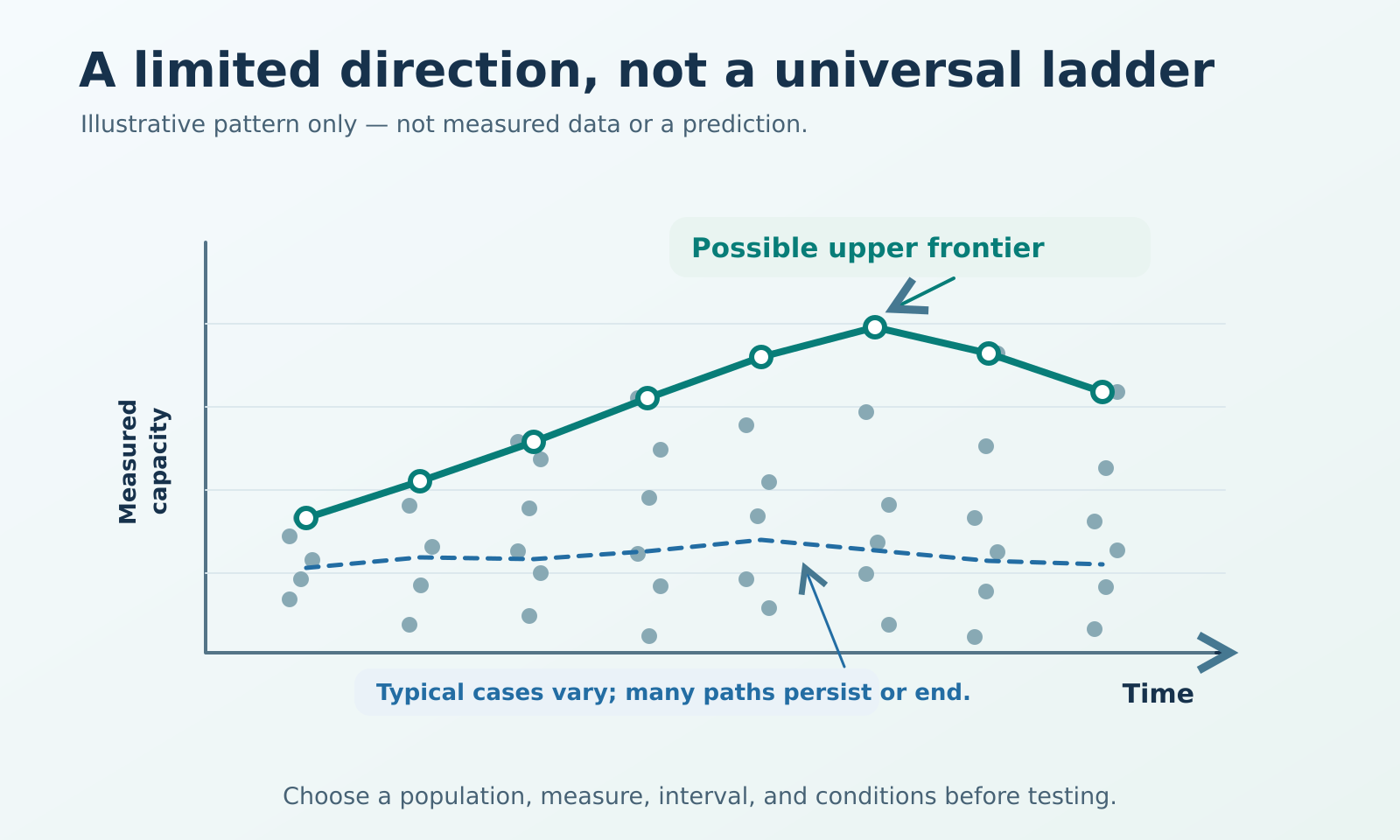
For human life, useful patterns to investigate include better information, cumulative learning, coordination across scales, protected cooperation, adaptability, resilience, and the capacity to correct errors. Their opposites matter equally: misinformation, domination, free-riding, rigidity, unjust burden shifting, overshoot, fragmentation, and collapse. The Universe Institute’s 10,000-Year Trap research applies a bounded version of this definition.
Think of a tailwind when conditions favor a voyage. It may help, but it never chooses the destination, repairs the boat, or protects people caught in the storm. We must ask which pattern applies, at what scale, for whom, at what cost, and for how long.
Six ways this limited progressive evolutionary worldview changes the view
1. Possibility replaces a guaranteed destination
Humanity can deliberately improve some capabilities and institutions. Humanity can also undo gains. Hope becomes the work of protecting options, not a forecast that everything will turn out well.
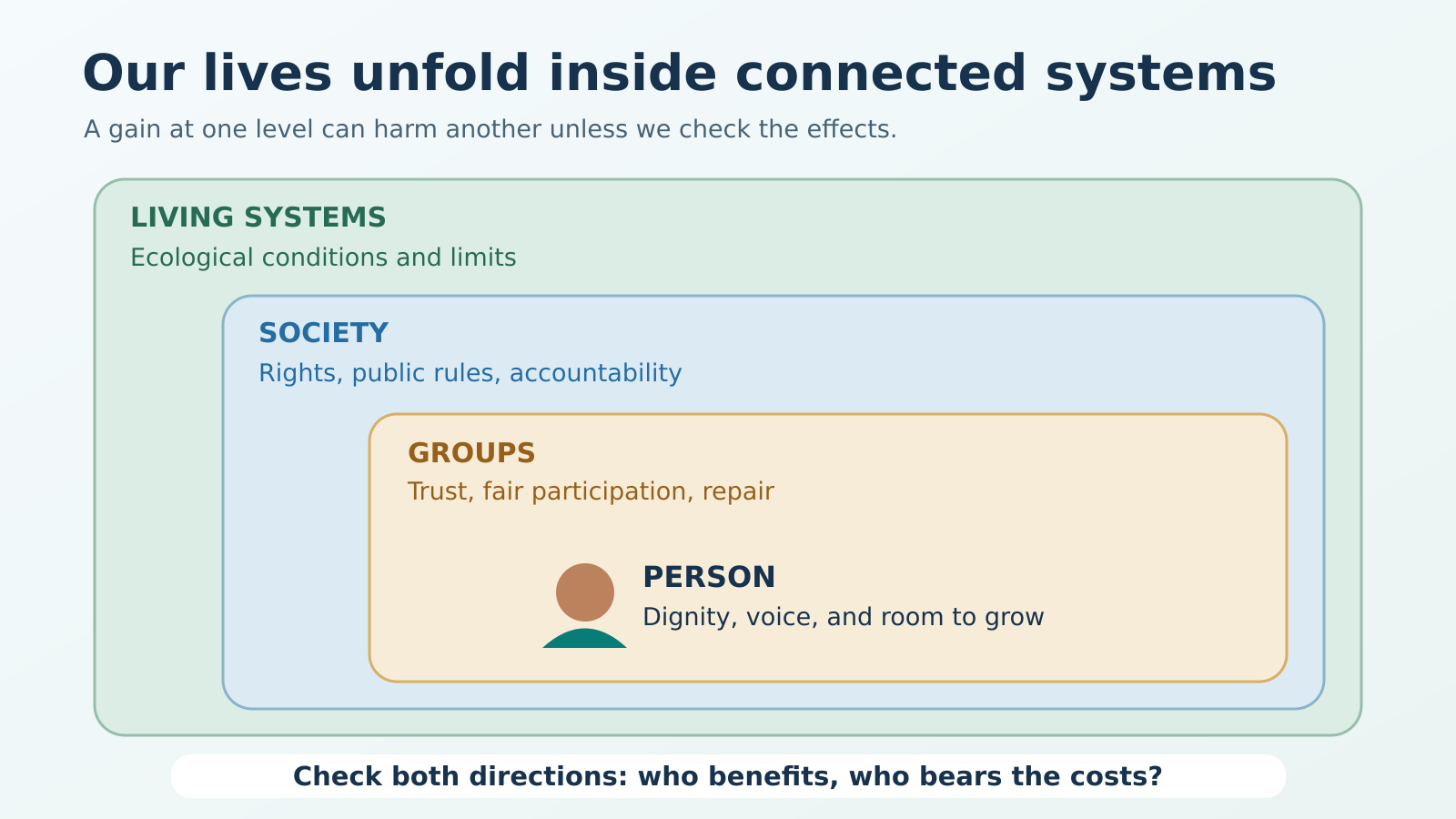
2. Individuals and groups are parts of nested systems
A person needs room to think, dissent, and live with dignity. A group needs trust and coordination. A society depends on ecosystems and on people outside its borders. An arrangement that enriches one part by disabling another may look successful briefly while undermining the larger system. Yet a powerful group can also use “the common good” to demand sacrifice from others. Both dangers require rights, voice, and accountability.
3. Learning becomes a form of courage
Our ancestors passed on tools, stories, skills, and errors. We can inherit and improve them. Admitting a mistake is a strength when it helps us protect what we value. We need honest evidence, plural perspectives, feedback, and institutions that can change without violence.
4. Cooperation becomes a design challenge
Warm intentions help, but durable cooperation also depends on fair participation, protection against exploitation, workable rules, and ways to repair harm. Cooperation can serve unjust aims, so its purpose and distribution must be examined. Research on conditions for cooperation and commons governance inform this question.
5. Meaning is something we can create responsibly
The fact that we are part of an ancient universe can evoke awe. It does not assign everyone the same job, identity, or final life purpose. People can find meaning in care, discovery, art, friendship, repair, service, contemplation, and the protection of future possibilities. Science informs what an action may do; people must still decide what is worth doing.
6. We can face hardship and build at the same time
Climate disruption, war, injustice, displacement, and institutional failures cause real suffering. Calling the suffering an “adventure” would be insensitive. Our next bold adventure is the constructive response: what we discover, protect, repair, learn, and build together. The good news is the existence of capacity and choice, not the absence of danger.
Three human adventures, updated
The earlier articles offered three inviting paths. Their strongest structure survives with more room for real lives and different values. These paths can overlap; no one must complete one before entering another.
Grow a life you can inhabit. Develop your health, understanding, relationships, skills, imagination, and ability to adapt. The measure is your chosen, humane goals, not a demand to become maximally complex or productive.
Help the circles you belong to work better. Use what you learn to support family, neighbors, teams, public life, and living systems. Listen to the people affected. Protect the individual’s rights while improving the group’s capacity to cooperate.
Join work larger than one lifetime. Help reduce avoidable harm and preserve options for children and future generations. This can mean local resilience, climate action, fair institutions, education, responsible technology, or careful research. No person has to do everything. Every durable contribution is a piece of a larger effort.

One connected nonprofit mission, four public doorways
- Universe Institute examines evidence, Limited Progressive Evolution, systems analysis, the 20 interacting causes and solutions of recurring civilizational dysfunction and injustice, and better reasoning tools. This is a research center for the global polycrisis.
- Job One for Humanity helps people understand climate risk and act through emissions reduction, preparation, adaptation, resilience, and, where needed, migration.
- The Way of the Universe develops the Universe Principles of Right Action and Right Attitude as a science-informed practical philosophy, with stated values and room for revision. A visitor can try them without accepting a cosmic destiny.
- Universe Spirit offers optional, personal exploration of meaning and spiritual experience. Its interpretations are not scientific conclusions or conditions for using the Institute’s work.
The 34 yer old non-profit FACTNet helps connect the mission. Movement identities, such as Evolutioneer or Universe Citizen, are optional ways to take part in work elsewhere in the network; they are not scientific ranks or required identities on this page.
Questions new readers often ask
Does the universe inevitably progress?
No. The bounded claim concerns some systems and measurable capacities under enabling conditions. Much of evolution consists of persistence, simplification, loss, and extinction.
Is a more complex society a better society?
No. Complexity can expand capacity or hide exploitation and create fragility. We judge outcomes using stated values such as dignity, fairness, safety, ecological viability, and freedom.
Does the worldview replace religion or personal philosophy?
It offers a shared, revisable way to connect evidence with chosen commitments. People of different faiths and none can examine the evidence. Optional spiritual interpretations belong in their own setting.
Must I become an Evolutioneer or Universe Citizen?
No. Those identities belong to different parts of the four-site mission. You can learn and contribute without adopting a label.
What is genuinely new here?
Many ingredients have long histories in evolutionary science, systems thinking, philosophy, and ethics. The Institute’s contribution is a bounded synthesis and an explicit method for testing whether those ingredients help with current human problems. It is a proposed worldview, open to criticism.
Where is the proof that it improves my life?
There is no universal clinical trial of this entire worldview. Specific practices have different levels of evidence. A personal experiment may teach you something locally, but it cannot prove the whole theory. The companion field guide shows how to test claims modestly.
Short glossary
Adaptation: A change that improves fit to a specified environment and criterion; it may carry costs elsewhere.
Conditional: True or useful only under identified circumstances.
Evolvability: A system’s capacity to generate and retain potentially useful variation; its measurement depends on context.
Limited Progressive Evolution: This project’s study of local, conditional, reversible increases in some forms of complexity, information use, organization, or agency, alongside regression and failure.
Open system: A system exchanging energy, matter, or information with its surroundings.
Statistical upper envelope: The frontier reached by some cases in a distribution, distinct from the average or the fate of every case.
Worldview: A revisable working map that connects facts, interpretation, values, and possible actions.
Reading and evidence
-
- Szathmáry and Maynard Smith, “The major evolutionary transitions,” Nature (1995). Important cases; the paper itself cautions against assuming every lineage grows more complex.
- Nowak, “Five rules for the evolution of cooperation,” Science (2006). Mechanisms and conditions for cooperation.
- Stewart, “The direction of evolution: the rise of cooperative organization,” BioSystems (2014). A stronger directionality thesis discussed here as an interpretation to test.
- Boyd, Richerson, and Henrich, “The cultural niche,” PNAS (2011). Social learning and human adaptation.
- O’Malley, Wideman, and Ruiz-Trillo, “Losing Complexity,” Trends in Ecology & Evolution (2016). Why simplification is part of evolutionary history.
- NASA, “How old is the universe?”. The approximate 13.8-billion-year timescale.
- The Universe Institute, The 10,000-Year Trap (2026). The project’s bounded definition and civilization-level application.
Try to challenge this page with AI
Copy a question into an AI system, then check its cited sources yourself:
-
- “Give the strongest evidence for and against a conditional upper-envelope trend in biological complexity. Separate measured distributions from moral interpretation.”
- “Name three cases where cooperation increased capacity and three where it strengthened domination. What changed the outcome?”
- “What would falsify the claim that truthful feedback and fair accountability improved a specific institution?”
- “Identify any sentence on this page that quietly turns an evolutionary fact into a moral command. Propose a repair.”
Next Important Reading About Limited Progressive Evolution and What Its Facts Can Mean For Improving Your Life
1. Read the Institute’s companion article, Why a Limited Progressive Direction Matters, for the explicit bridge from facts to values.
2. Read the Institute's position on why the naturalistic fallacy does not prevent principles found in limited progressive evolution from aligning values with progressive evolution scientific facts to point to potentially better and more successful human behaviors.
3. You can also browse the Institute’s limited progressive evolution research library.
Showing 1 reaction